


By Zia Khan /Staff Reporter
Qatari authorities are contemplating more protectionist measures including stricter monitoring of cyber traffic to protect youth from exposure to inappropriate online content like pornography or hate material deemed offensive to religion and culture.
Officials at the ictQATAR — a body that regulates telecommunications in the country — told Gulf Times yesterday the decision to further tighten cyber regime is taken after recent surveys suggest almost 30% youth are vulnerable to unsuitable substance.
Though these surveys do not explicitly mention what falls under the category of inappropriate content, officials said it is a veiled reference to pornography and emotionally disturbing words and images.
In most cases, they explained, it is insulting to religion, culture and morality.
These officials spoke on the sidelines of a conference to mark the Safe Internet Day organised jointly by the ictQATAR and Qatar University.
Several dozen young students from across the spectrum of Qatari educational institute participate in the conference, some of them with striking ideas on online safety, to celebrate the day that is commemorate globally.
Experts believe fresh measures will put more curbs on Internet accessibility in Qatar, one of the tech savvy nations in the region with highest number of smart phone penetration.
Officials, however, did not elaborate what else would constitute the contours of new regulations because proposals are still at the initial stage.
They also appeared unsure how long it can take before overhauling of laws actually takes place.
Speaking at the conference earlier, representatives from youth organisations and community leaders highlighted what they described risks attached to the use of Internet in the modern world where people are exposed to some of heinous cyber crimes like bullying.
At the heart of almost a daylong debate was a question whether people should reveal their identity on social networking sites like Facebook and Twitter and how they can play it safe while being online.
“The key is not to get carried away,” remarked Mona Younes, seniour e-learning specialist at ictQATAR.
She said as many as two thirds of young people in Qatar take freedom to use Internet for granted and are not careful in their interaction to other people on social networking platforms.
“A casual approach can hurt you…it can have harshest of consequences,” said Mona, who hails from Egypt.
Capt. Banna al-Khulaifi from juvenile police department of the Ministry of Interior suggested people to avoid going too far with the people they know only on the Internet. She laid a special emphasis on not posting photographs on social networking websites casually.
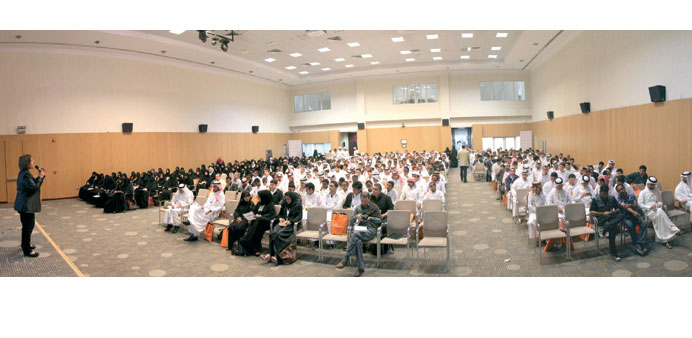
Students, others participate in cyber safety conference.