


By Dr SMM Nainar/Doha
In retaliation to the sanctions imposed on it by the United States over the nuclear issue, Iran is threatening to close the Strait of Hormuz - one of the world’s most strategically important choke points and the only sea passage to the open ocean - for transporting more than 40% of the world’s oil and 85% of the oil produced by the Gulf Co-operation Council (GCC) countries.

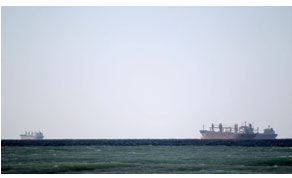
Oil tankers cruise out the Strait of Hormuz off the shores of Tibat in Oman
The Strait stretches over 34 nautical miles. Ships move through in separate inbound and outbound lanes to reduce the risk of collision. The traffic lane is 10km wide, separated by a 3km wide separation median.
To traverse the Strait, ships pass through the territorial waters of Iran and Oman under the provisions of the United Nations Convention on the Law of the Sea.
Iran can very easily plant 20 sea mines in the 10km stretch and block the traffic. The US and Europe will no doubt be deprived from oil supplies but the countries friendly to Iran will also suffer. China imports 426,000 barrels of petrol per day (bpd) while Japan, India, Italy and South Korea import 362,000, 345,000, 208,000 and 203,000 bpd.
Iran cannot afford to harm the economic interests and the political ties with these countries.
It has also to take into account that blocking the strait would be a violation of Article 7 of the UN Charter, which allows military intervention if there is a perceived threat to peace. Since the Strait of Hormuz is an international sea passage, no country can have an exclusive hold on it.
Iran may not be a signatory of the International Maritime Accord of 1982, but this does not absolve it of the legal consequences of closing the strait.
Iran will also suffer in its trade relations in view of the fact that many of its commercial harbours are situated in the Arabian Gulf. To offset the consequences of the closure of the strait, Saudi Arabia has already started transporting oil through the Trans-Arabian Pipeline (Tapline) via the Red Sea and the Mediterranean.
The UAE has started developing the Al Fujairah sea port and has laid out pipelines for transporting more than 1.5mn bpd from June this year.
Iran, meanwhile, has started turning to friends in Latin America in an effort to compensate the loss of revenues.
In spite of the defiant positions taken by the West and Iran, the possibility of a military conflict looks very remote.
Historically, the Strait of Hormuz was in the 14th and 15th centuries an Arab feudal principality holding sway over many of the neighbouring territories including the region of Fars in present-day Iran.
lBased on articles by Dr Zafer Mohammad al-Ajamy and Dr Saeed Hareb; Al-Arab daily, Doha; January 11 and 16