
Reuters/Athens
Greece’s parliament approved deeply unpopular austerity measures despite worsening street violence yesterday, in a vote vital to secure international aid and prevent the eurozone’s first sovereign debt default.

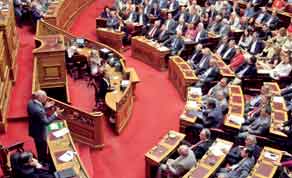
Greek Prime Minister George Papandreou (standing left) talks to lawmakers after voting in parliament in Athens yesterday on new austerity package. Amid protests, MPs approved €28.4bn ($40.7bn) in spending cuts, unlocking a €12bn payout from the European Union and the International Monetary Fund
Lawmakers passed a five-year package of spending cuts, tax rises and state asset sales by a comfortable margin of 155 votes to 138 in a roll-call vote, handing a victory to embattled Prime Minister George Papandreou.
“We must avoid the country’s collapse at all costs. Now is not the time to step back,” the Socialist premier told lawmakers just before the vote.
The solid margin suggested the government should be able to push through laws implementing specific budget measures and asset sales today, clearing the last obstacle to obtaining €12bn ($17.3bn) of emergency loans.
But with the country on the brink of bankruptcy and social unrest mounting, it is unclear whether the government can stick to the tight schedule imposed by the European Union and the International Monetary Fund to implement the austerity steps, even if it wins all this week’s parliamentary votes.
The full pain of pay and benefit cuts and sharp tax increases has yet to be felt, and public anger is boiling.
Outside parliament, there were clashes between stone-throwing masked youths and riot police, who fired clouds of teargas from behind steel crash barriers to keep rioters at bay.
Chancellor Angela Merkel of Germany, Europe’s reluctant paymaster and the main contributor to the bailout of Greece, was quick to praise the “brave” vote. But Finance Minister Wolfgang Schaeuble stressed the importance of “implementing these (measures) with resolve in the coming weeks, months and years”.
The presidents of the European Council and the European Commission, Herman van Rompuy and Jose Manuel Barroso, said in a joint statement that Greece had taken “a vital step back—from the very grave scenario of default”.
However, many economists and investors still expect Greece to default in the medium term because its €340bn pile of sovereign debt is so huge, about 150% of the country’s annual economic output. A senior German ruling coalition politician, Free Democratic floor leader Rainer Bruederle, said that a debt restructuring was inevitable.
Expectations for a positive vote and progress in talks between banks and eurozone governments on a rollover of privately held Greek debt lifted the euro and global stocks yesterday. Prices of bonds issued by the zone’s weaker states rose.
But markets then fell back slightly after news of parliament’s decision.
“This is logical and may continue over the next couple of hours and days as markets will quickly realise that this is only a first step on the road to recovery,” said Philippe Gijsels, head of research at BNP Paribas Fortis Global Markets.
“We still expect a hot, nervous and volatile summer.”
Despite a threat by trade unions staging a 48-hour general strike to prevent lawmakers entering the colonnaded parliament building, deputies were able to reach the chamber. Strikes and sporadic violence have not blown the government off course so far, but its approval rating has plunged in recent months.
Only one deputy in the ruling PASOK party voted against the plan and was immediately expelled from the party by Papandreou. At least one opposition deputy broke ranks with the main conservative New Democracy party and voted “yes”.
PASOK now holds 154 seats in the 300-member chamber and it was helped yesterday by the abstention of a small centre-right splinter group of five deputies led by former foreign minister Dora Bakoyanis.
The EU and the IMF have insisted Greece must adopt the austerity plan, which seeks to save the government €28bn, in order to receive its next slice of aid. Without the money, Athens would run out of cash within weeks.
In May last year Greece signed a €110bn bailout deal with the EU and the IMF, which later jumped in to keep Ireland and Portugal afloat as the eurozone reeled from high government debt in the wake of the global financial crisis.
If Greece’s fiscal legislation passes today, eurozone finance ministers meeting in Brussels on Sunday are expected to agree to release their part of the next aid tranche, with the IMF following on July 5.
Attention will then switch to putting together a second and longer-term rescue package for Greece of about the same magnitude as the initial €110bn bailout.
The new programme would involve some €30bn in private-sector participation via a “voluntary” rollover of maturing debt, a similar sum from Greek privatisation revenues, and an expected 55bn euros in new official funding.
Banking sources said politicians and commercial bankers were confident that credit rating agencies would accept a French proposal for a voluntary private sector rollover of Greek debt without triggering a default or a payout of credit insurance.
The agencies have made no public comment on the plan, details of which are still under negotiation.
Eurozone banks and insurers are considering a scheme under which private bondholders would reinvest half of the proceeds of maturing Greek debt in new 30-year bonds paying 5.5% interest plus a bonus linked to Greece’s economic growth rate.