


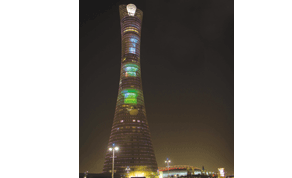
The 12th Arab Games is more proof that Qatar has evolved into one of the world’s main and sought-after sport destinations. Since 2004, Qatar has hosted a significant number of major sporting events, not only at a continental level, but also at a global one. Most notably, Qatar has been chosen to organise and host the 22nd FIFA World Cup in 2022.

Under the auspices and guidance of the Qatar Olympic Committee, the nation of Qatar hosts important events in many different sports, but the milestone event was the Asian Games held in Doha in December, 2006. The Asian Games proved to be a reference point for Asian sport, as well as a springboard for Qatar to develop into one of the world’s top sports destinations.
Below is a list of the major sporting events that have been hosted in Doha since 2004:
TOP EVENTS HOSTED BY QATAR
2004 Asian Handball Championships
2004 ITTF World Team Table Tennis Championships
2004 FIM Moto Racing World Championships
2005 Asian Basketball Championships
2005 FIM Moto Racing World Championships
2005 World Weightlifting Championships
2005 West Asian Games
2006 Asian Sailing Championships
2006 FIM Moto Racing World Championships
2006 Asian Games
2007 FIM Moto Racing World Championships
2008 Asian Indoor Athletics Championships
2008 FEI Equestrian Global Champions Tour
2008 FIM Moto Racing World Championships
2008 Asian Youth Wrestling Championships
2008 Asian Optimist Sailing Championships
2008 WTA Tour Tennis Championships
2009 FEI Equestrian Global Champions Tour
2009 FIM Moto Racing World Championship
2009 Asian Fencing Championships
2009 WTA Tour Tennis Championships
2009 FIVB Club World Championships
2009 ISF World Gymnasiade
2010 IAAF World Indoor Championships
2010 FEI Equestrian Global Champions Tour
2010 FIM Moto Racing World Championships
2010 IAAF Diamond League
2010 IHF Handball Super Globe
2010 WTA Tour Tennis Championships
2010 FIVB Club World Championships
2010 ISAF World Junior 470 Sailing C’ships
2011 Asian Football Cup
2011 FEI Equestrian Global Champions Tour
2011 FIM Moto Racing World Championships
2011 IAAF Diamond League
2011 IHF Handball Super Globe
2011 FIVB Club World Championships
Next up on Doha’s busy sporting agenda are the 12th Arab Games, to be held from 9-23 December 2011.
Qatar will also host the 2012 Asian Shooting Championships, the 2015 Handball World Championships and the 2022 Football World Cup, while Doha is also bidding for the 2020 Olympic Summer Games.
ARAB GAMES CHRONOLOGY EDITION YEAR HOST CITY
1st 1953 Alexandria, EGYPT
2nd 1957 Beirut, LEBANON
3rd 1961 Casablanca, MOROCCO
4th 1965 Cairo, EGYPT
5th 1976 Damascus, SYRIA
6th 1985 Rabat, MOROCCO
7th 1992 Damascus, SYRIA
8th 1997 Beirut, LEBANON
9th 1999 Amman, JORDAN
10th 2004 Algiers, ALGERIA
11th 2007 Cairo, EGYPT
12th 2011 Doha, QATAR
MEDAL TALLY AFTER 11 ARAB GAMES
Twenty-three different NOCs have won medals in the history of the Arab Games. Egypt is ranked first with a total of 1,066 medals, including 452 gold, 333 silver and 281 bronzes, while Comoros Islands is the only NOC yet to win a medal is. The overall medal tally after 11 editions of the Arab Games is as follows:
*Countries are listed in terms of number of gold medals
COUNTRY G S B SUM
1 Egypt 452 333 281 1,066
2 Syria 279 228 282 789
3 Morocco 220 196 203 619
4 Tunisia 203 165 235 603
5 Algeria 201 222 249 672
6 U.A.R. * 127 24 54 205
7 Lebanon 70 114 107 291
8 Iraq 66 103 117 286
9 Jordan 52 82 56 190
10 SaudiArabia 40 73 97 210
11 Qatar 33 34 45 112
12 Libya 17 25 35 77
13 Sudan 16 28 22 66
14 Emirates 16 20 26 62
15 Bahrain 11 14 24 49
16 Oman 10 7 12 29
17 Kuwait 6 5 15 26
18 Palestine 4 27 55 86
19 Yemen 3 5 12 20
20 NorthernYemen ** 1 1 2
21 Somalia 4 1 5
22 Djibouti 1 1
23 SouthernYemen ** 1 1
24 Comoros Islands
* United Arab Republic (Egypt and Syria from 1958 until 1961).
Egypt continued to be known as U.A.R. until 1971
** Northern Yemen and Southern Yemen unified as Yemen in 1990
UANOC - THE ARAB GAMES UMBRELLA
The Union of Arab National Olympic Committees (UANOC) is the highest organisation of Arab sports, as it includes the 21 Arab NOCs and all of the Arab Union. It was founded in 1976 and is based in Riyadh, Saudi Arabia, under the presidency of IOC member Sultan bin Fahad bin Abdulaziz Al Saud of Saudi Arabia.
In October, 2010, the Secretary General of the Qatar Olympic Committee, Sheikh Saoud bin Abdulrahman Al-Thani, was appointed as the UANOC deputy president.
The main role of UANOC is to promote sports in Arab countries and work with Arab and international sports organisations to raise the level of all sports.
This mandate includes the supervision and coordination of the Arab Games and the promotion of the Olympic movement’s goals in the Arab world.
It also focuses on the importance of physical education, developing skills, encouraging creativity and consolidating the spirit of citizenship and belonging among Arab youth.
UANOC is composed of a Public Assembly, an Executive Office and 13 sub-committees. The Union has set up an extensive relationship networks with bodies such as the League of Arab States, National Olympic Committees in Arab states, International Olympic Committee, International Federations, Olympic Solidarity Commission, International Olympic Academy, Federation of International Sports Federations, UNESCO, Federation of European Olympic Committees and various government agencies responsible for sport, physical education and sports medicine.
QATAR OLYMPIC COMMITTEE PROFILE
Qatar loves sport and the Qatar Olympic Committee (QOC) is committed to providing opportunities for all in the community to participate in sport and sports-related activities that contribute to the physical and spiritual health of individuals and communities in Qatar and around the world.
The investment that the QOC is making in athlete and venue development, sports bodies and community programs will ensure that Qatar maintains its progress and ensure success for the nation in the future.
This reflects the exact meaning of the main QOC aim, which expresses its sporting vision: “To become a leading nation in bringing the world together through sports.”
The mission of the Qatar Olympic Committee is to put sport and physical recreation activity everywhere in Qatar so as to have harmonious development of men and women.
It includes various objectives, which support the progress and the promotion of sports at all levels and also protects the true athletic spirit, the fair play and the Olympic Movement, in accordance with the Olympic Charter.
QOC was founded in March 14, 1979, and joined theInternational Olympic Committee in 1980, the Olympic Council of Asia in 1981 and the Arab Sports Games Federation in 1982. H.H. Sheikh Tamim bin Hamad al-Thani is the current president of the QOC, a position he has held since December 12, 2000.
PARTICIPATING COUNTRIES
(Code, National Olympic Committee)
Algeria ALG Comité Olympique Algérien
Bahrain BRN Bahrain Olympic Committee Comoros COM Comité Olympique et Sportif des Iles Comores
Djibouti DJI Comité National Olympique Djiboutien
Egypt EGY Egyptian Olympic Committee
Iraq IRQ National Olympic Committee of Iraq
Jordan JOR Jordan Olympic Committee
Kuwait KUW Kuwait Olympic Committee
Lebanon LIB Lebanese Olympic Committee
Libya LBA Libyan Olympic Committee
Mauritania MTN Comité National Olympique et Sportif Mauritanien
Morocco MAR Comité Olympique Marocain
Oman OMA Oman Olympic Committee
Palestine PLE Palestine Olympic Committee
Qatar QAT Qatar Olympic Committee
Saudi Arabia KSA Saudi Arabian Olympic Committee
Somalia SOM Somali Olympic Committee
Sudan SUD Sudan Olympic Committee
Tunisia TUN Comité National Olympique Tunisien
United Arab Emirates UAE United Arab Emirates National Olympic Committee
Yemen YEM Yemen Olympic Committee
ARAB GAMES INFORMATION KEY FACTS AND FIGURES
Event Dates 9-23 December 2011
Days of Competition* 17
Participating NOCs 22
Sports 29 (including 2 Paralympic sports)
Number of Events 353 (217 men/128 women/8 open)Competition Venue Complexes 14
Athletes and Team Officials 6,000
Technical Officials 1,800
Media Representatives 1,100
Volunteers 4,000
Games-Time Staff 5,000
VIPs 500
COMPETITION VENUES
1 Al Gharafa Sports Club Indoor Hall
Football Stadium
Beach Volleyball Arena
2 Al Rayyan Sports Club Football Stadium
Indoor Hall
3 Al Sadd Sports Club Football Stadium
Indoor Hall
4 Al Shaqab Main Arena
5 Aspire Zone Aspire Dome:
Hamad Aquatic Centre; Indoor Hall Khalifa Stadium; Women’s Indoor Hall
6 Doha Golf Club
7 Doha Sailing Club
8 Khalifa International Tennis & Squash
Complex:
Squash Centre; Tennis Indoor Hall
Tennis Outdoor; Courts
9 Lusail Cycling Circuit Cycling
10 Lusail Shooting Complex Archery Range
Shooting Range
11 Mesaieed Endurance Course Race Track
12 Qatar Billiards & Snooker Federation Indoor Hall
13 Qatar Bowling Centre
14 Qatar Sports Club Indoor Hall
HOSTS INFO
Qatar participation in its first Olympic Games in 1976 in Montreal, Canada and has won two medals. The first was the men’s 1,500m bronze that Mohammed Ahmed Sulaiman captured in Barcelona in 1992. Eight years later at the 2000 Sydney Olympic Games, weightlifter Said Saif Assaad won a bronze medal in the men’s 105kg.
Another key moment for the QOC came in 1978 when Qatari athletes participated for the very first time at the Asian Games. Since then Qatar has won a total of 92 medals, including 27 gold, 28 silver and 37 bronze. At the 2006 Asian Games hosted in Doha, athletes from Qatar won a record 32 medals (nine gold, 12 silver and 11 bronze), while at the 2010 Asian Games held in Guangzhou, China, they claimed 16 medals (four gold, five silver and seven bronze).
In Arab Games competition, Qatar debuted in 1976 in Damascus, Syria, and since then has won 112 medals, including 33 gold, 34 silver and 45 bronze.
HISTORY OF THE ARAB GAMES
The Arab Games were the brainchild of Abdul Rahman Hassan Azzam, the first General Secretary of the Arab League, serving from 1945-1952. In 1947, Azzam submitted a memorandum to the League, advocating a multi-sport tournament that involved the participation of all Arab countries.
According to Azzam, sport could serve as the best way to connect the youth of Arab countries and enable them to build the future of the Arab identity.
As a favourite pastime of young individuals, sporting tournaments encourage them to reach out across boundaries, bond with fellow Arabs and eliminate differences among them.
Azzam then announced that the youth of the entire Arab world was eager to gather for an annual tournament to be held in Arab cities.From then onwards, the youth of Arab nations began to look forward to the Arab Games as a means of uniting them on sporting, social and spiritual platforms while igniting and encouraging a competitive spirit amongst athletes and communities alike.
However, the Arab Games concept did not gain official approval until 1953, when Eng. Ahmed El Demerdash Touny, an Egyptian national and a member of the International Olympic Committee (IOC), managed to convince the concerned parties within the Arab League that an Arab Games tournament would be instrumental to the overall success of the Arab identity.
In response to Touny’s proposal, the Arab League agreed on establishing the Arab Games, and Egypt became the first country to organise an Arab Games tournament. It was held in the scenic and culturally rich city of Alexandria from 26 July-10 August, 1953 with eight Arab nations competing in the inaugural tournament.
Since then 11 editions of the Arab Games have been held in various Arab cities, the last being in 2007 in Cairo, Egypt. It earned widespread praise for its organisation, technical management and quality of participants.
Women first competed in the 1985 Arab Games held in Rabat, Morocco.