


 |
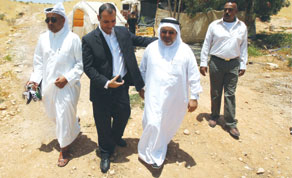
| Qatar Charity officials working to establish new projects in Palestine |
Ramadan Assi, director of Qatar Charity Office in Palestine, said that the charity would implement a comprehensive health and agricultural development programme for the village alongside existing solar energy projects.
The Faroosh Beit Dagan project will improve the living conditions of approximately 220 families (around 1200 individuals) through an active community centre with outreach programmes to tackle and solve local community problems.
The centre will help deliver health, educational and social services.
The project will also provide assistance with land reclamation and methods for the improvement of water resources and agricultural output.
It will also provide solar energy derived electricity to meet the village’s everyday power needs.
The village is in the Al Ghoar valley, which circumvents the borders of Jerusalem from the East side.
Most of the territory here has been confiscated or designated as forbidden military zones by the Israeli occupation. Palestinians now live in the little land that is left, on the cultivated land, in natural caves or in tents and tin shacks.
These shelters lack the basic amenities of life and this causes many social, health and economic problems. .
The Israeli settlers seized 11,000 acres of village land and left only 3,000 acres for the Palestinians. Even this land is under continuous threat from Israeli settlers.
The village inhabitants live there without electricity and water during winter. Some leave in the summer as temperatures rise to 50 degrees. Some 500 people live on the Israeli settlement of 11, 000 acres.
They control the main roads and enjoy electricity from the carrier line that passes thorough Faroosh Beit Dagan village.
The villagers are not allowed either electricity or use of the road.
This project is to empower the Palestinian population in their cities and villages and support them as they face repressive Israeli policies and settlement practices.
These policies and practices divided Palestinian towns and villages and cut communications.
They disrupted development and devoured most of the Palestinian territories, especially the so-called (E) areas. The denial of land, water, electricity and decent housing displaced the population..
Ramadan Assi said that Qatar Charity worked with local institutions and organisations to design of its sustainable development programme.
This is a pilot project that applies integrated developmental approaches to enable the village to address problems. If successful, it will be repeated in other needy remote areas.