


By Gautaman Bhaskaran
Many films in India arrive without as much as a poster campaign, but end up drawing your attention, and holding it too. And, well moving you. Despite some flaws, Subhash Kapoor’s Jolly LLB, which opened last Friday, is one such delectable movie.
Kapoor began as a political journalist in the Delhi of the 1990s, graduating to making short films before attempting his first feature in 2007 on cricket (what else), Say Salaam India. His next, Phas Gaye Re Obama, was a quirk tale of gangsters in recession-hit India. Both sank for different reasons. The second, for instance, had too many characters in a plot laid too thin.
However, Kapoor appears to have struck luck the third time around with his, Jolly LLB, which has been attracting good reviews. I quite enjoyed it, in spite of its rather listless first half, songs that impeded the narrative flow and romance (Amrita Rao and Arshad Warsi), which was important to the plot but did not quite take off.
Marvellous performances by Boman Irani (but of course) and Warsi (again, but of course) just elevate the movie to an exciting high. But it is Saurabh Shukla as Justice Tripathi who walks away with an Oscar (so to say) for acting. The way his character has been written must serve as a compulsory text for all the Bollywood biggies who end up scripting caricatures, weak two-dimensional men and women.
Shukla is brilliant as a harassed judge, who despite his discomfort in having to hear boring arguments in a hot and humid courtroom with a nagging indigestion, has a fine sense of humour.
Justice Tripathi is a judge in a district court, whose nauseating personal habits and corrupt practices make him the butt of SMS jokes. But there comes one defining moment in his life when he takes control of his court (“This is my court” he thunders at one point), throws “evidence” out of the window and listens to his heart to punish the errant, rich kid — who is accused of driving in his drunken state, a luxury car over sleeping pavement dwellers in Mumbai, killing five and maiming one.
The judge says in the end that every time he presides over a case, he knows who the culprit is, but keeps waiting for that one piece of evidence which will nail the guilty. Often, it never comes, and Tripathi is forced to — as he has to follow the legal system of going by evidence — let the culprit go scot free.
But this time, Tripathi, says, he does not want to go by evidence alone to punish the young man, whom the judge knows is clearly at fault. Seven years in prison, he rules, much to the chagrin of the youth and his parents, who had hoped to buy the boy’s freedom for a price.
We know this story all too well, for it happened in Delhi some years ago
when the rich grandson of a well-known public figure ran his swanky car over men sleeping on the sidewalk killing five or six of them. The young man tried escaping jail by hiring a top shot lawyer and bribing eyewitnesses.
Eventually, he was jailed for five years. (As is the norm in Indian cinema, Jolly LLB disclaims all this.)
In Jolly LLB, the high profile lawyer is Tejinder Rajpal (Irani), whose walk and demeanour cause a stir in courts. The judges are in awe of him — for he never loses an argument or a case — and so is Tripathi, who early in the film is shown asking the lawyer for a favour. It will be done, replies Rajpal, and the viewer is left with a nagging doubt that the case is all but fixed even before it begins.
The case is closed, the verdict given, and the accused declared not guilty.
However, Jolly or Jagdish Tyagi (Warsi), a fresher in the legal field, files a public interest litigation to have the case reopened. Jolly has his head and heart in the right places, and believes that his journey from small town Meerut to India’s capital of New Delhi could not have begun on a nobler note. After all, he was trying to seek justice for the poor, crushed out of existence by an arrogant man who in both his drunken and sober moments thinks that money can buy him his freedom.
Yes, even Jolly wavers when currency notes are waved in front of him by a man sent by the wily Rajpal, who can neither afford to lose the big bucks promised by the accused’s family nor the case to a small fry like Jolly. For Jolly the case is a big chance to hit the limelight, with media attention focused on it, because a rich and famous family is involved. The case has all the ingredients of a thriller: a corrupt judge, a lawyer noted for his notorious ways to win and a struggling David.
But Jolly LLB is not that Biblical story, and the movie’s twists and turns, characters and the little scenes they play out are riveting. Some of Tripathi’s quips are hilarious — like when he orders the rich family’s driver to squat in obeisance after he had been caught lying.
It was also rib-tickling to see a lowly cop auction money-spinning posts, with permission, as he says, from the bosses. Watch the doddering old policeman sent to protect Jolly who cannot even bear the weight of his gun.
Admittedly, no great surprise awaits us at the end: we know the underdog will win, we want him to. But Kapoor gives us characters whom we cannot easily forget. Irani who shakes his fist and tells the court that he will move heaven and earth to get his client out is absolutely believable. Warsi, who is willing to gamble by taking on the legal lion, is so eloquently controlled that we want to clap every time he beats his opponent in the verbal duel, often aided and abetted by Shukla.
People actually clapped in the cinema where I watched the film, conveying not just a strong resentment against the wily ways of the rich, but also a sense of fulfilling joy in seeing the triumph of the downtrodden.
Yes, we all wanted Jolly to win — and not just because Kapoor’s story and script were skilful and convincing. There was something more than this. The helmer had spun a tale that went beyond looking like an Earl Stanley Gardner plot. Jolly LLB played on our emotions and touched our hearts.
(Gautaman Bhaskaran has been writing on Indian and world cinema for more than 30 years, and may be e-mailed at [email protected])
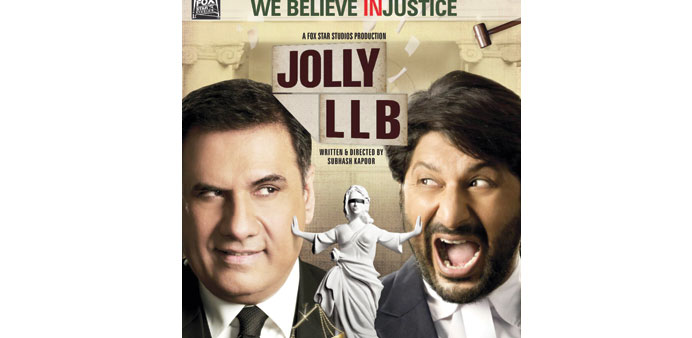
A promotional poster for Jolly LLB, a legal drama with a comedic twist.