


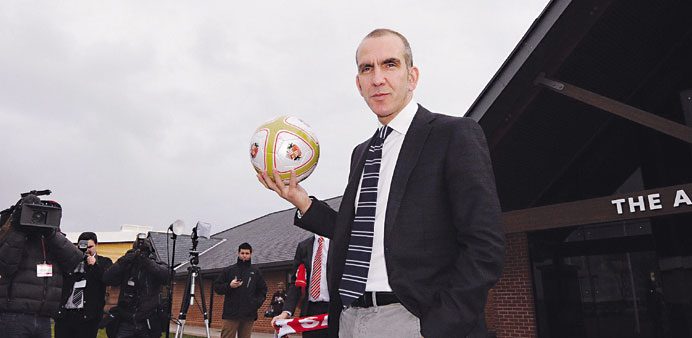
New Sunderland manager Paolo Di Canio holds up a ball during his unveiling at the Academy of light training facility in Sunderland yesterday.
Reuters/London
New Sunderland manager Paolo Di Canio described the controversy over his appointment as “ridiculous and pathetic” and refused to answer questions about whether he held fascist beliefs in his first news conference yesterday.
Di Canio, 44, replaced Martin O’Neill at the relegation-threatened Premier League team on Sunday, a move that sparked the resignation of a former minister from the club’s board.
David Miliband, a departing Member of Parliament and a former foreign secretary, stepped down because of remarks the ex-Swindon Town boss made to Italian news agency ANSA in 2005 when he said: “I am a fascist, not a racist”.
“I don’t have to answer any more this question, there was a very good statement from the club, (with) very, very clear words that came out from me,” the Italian said yesterday in an effort to steer talk away from politics and back to football.
“I don’t want to talk any more about politics for one reason because I’m not in the House of Parliament, I’m not a political person, I will talk about only football.”
Di Canio had sought to dampen the fires on Monday by releasing a statement that suggested he had been quoted out of context. “I expressed an opinion in an interview many years ago. Some pieces were taken for media convenience,” he said.
The Italian was given the job after a 1-0 defeat to Manchester United on Saturday prompted the surprise sacking of O’Neill.
Sunderland are 16th in the 20-team table and without a win in eight games. Asked whether he thought he could steer Sunderland away from relegation danger, Di Canio said he would bet everything he had on them not finishing in the bottom three.
“When I got the call from Ellis Short, I felt fire in my belly. I would have swum to Sunderland to take the job,” he added. “The press like to call me the mad Italian but I would confidently bet everything I have on Sunderland remaining in the top flight.”
Di Canio had a colourful playing career with clubs including Juventus, AC Milan, Lazio, West Ham United and Celtic, but has never managed in the top flight and joins Sunderland six weeks after quitting third-tier Swindon Town.
Never far from the headlines, he is remembered for pushing over a referee while playing for Sheffield Wednesday in England and drew outrage in 2005 when he celebrated his Lazio side’s derby win over AS Roma with a fascist-style salute.
“With my energy I’m sure we can get something from the next seven games. I hope my ways give the team more confidence on the pitch,” he added. “Players need to fight for the shirt - go out on that pitch ready to sweat and shed blood for the club.
“It’s important that the fans are happy with how the team perform and I hope to achieve that. We’re all working towards the same goal. I want to take things step by step. Firstly, it’s Chelsea (on Sunday) and we will be fully focused for that game.”
Miners demand return of banner
A local miners’ group has criticised Sunderland football club for appointing Paolo Di Canio as manager and demanded that a banner that has been on loan to the club for 15 years is returned. Dave Hopper, general secretary of the Durham Miners’ Association, said the decision to appoint Di Canio was an insult to those from north-east England who fought and died fighting fascism. Hopper was a miner for 27 years at Wearmouth colliery, which was on the site where the Stadium of Light now stands. He said: “We are not prepared to have a banner in the ground where that man is one of the leading protagonists. The club professes to be a community club but when you look at the man they have appointed it is certainly not going to do the community much good. It is going to be an encouragement to all these right-wing groups that are already running about here the EDL and BNP.” Wearmouth colliery closed in 1993. Work began on Sunderland’s new stadium in May 1996, opening in July 1997. Since then the Wearmouth Colliery banner has been displayed just inside the main entrance to the ground.