


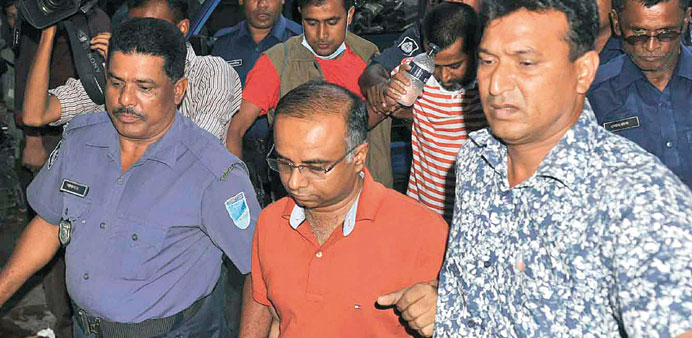
An arrested owner, centre, of a garment factory based at the eight-storey Rana Plaza compound which collapsed outside the capital, is escorted to an appearance at the court in Dhaka yesterday.
Reuters/Dhaka
Two factory bosses and two engineers were arrested in Bangladesh yesterday, 72 hours after the collapse of a building where low-cost garments were made for Western brands, as the death toll rose to 340 but many were still being found alive.
The owner of the eight-storey building that fell like a pack of cards around more than 3,000 workers was still on the run. As many as 900 people could still be missing, police said.
Police said two of his relatives had been detained to compel him to hand himself in, and an alert had gone out to airport and border authorities to prevent him from fleeing the country.
Officials said Rana Plaza, on the outskirts of the capital, Dhaka, had been built illegally without the correct permits, and the workers were allowed in on Wednesday despite warnings the previous day that it was structurally unsafe.
Two engineers involved in building the Rana Plaza were also arrested at their homes early yesterday, Dhaka district police chief Habibur Rahman said. He said they were arrested for dismissing a warning not to open the building after cracks were noticed on Tuesday.
The owner and managing director of the largest of the five factories in the complex, New Wave Style, surrendered to the country’s garment industry association during the night and they were handed over to police.
The factory, which listed many European and North American retailers as its customers, occupied upper floors of the building that officials said had been added illegally.
“Everyone involved - including designer, engineer, and builders - will be arrested for putting up this defective building,” said junior internal affairs minister Shamsul Huq.
Yesterday, Canada’s Loblaw, a unit of George Weston and which had a small number of “Joe Fresh” apparel items made at one of the factories, said it was working with other retailers to provide aid and support.
It said it was sending representatives to Bangladesh and was also joining what it described as an urgent meeting with other retailers and the Retail Council of Canada.
Wednesday’s collapse was the third major industrial incident in five months in Bangladesh, the second-largest exporter of garments in the world. In November, a fire at the Tazreen Fashion factory on the outskirts of Dhaka killed 112 people.
Such incidents have raised serious questions about worker safety and low wages, and could taint the reputation of the poor South Asian country, which relies on garments for 80% of its exports.
Anger over the working conditions of Bangladesh’s 3.6mn garment workers - most of whom are women - has grown since the disaster, triggering protests. Hundreds were on the streets again yesterday morning, smashing and burning cars and sparking more clashes with police who responded with tear gas.
Remarkably, people were still being pulled alive from the precarious mound of rubble - 20 in all since dawn yesterday.
“We must salute the common people who dared to enter the wreckage to rescue them, as even our professionals didn’t dare to take the risk,” Mizanur Rahman, deputy director of the fire service, said.
Marina Begum, 22, told of her ordeal inside the broken building for three days.
“It felt like I was in hell,” she told reporters from her hospital bed. “It was so hot, I could hardly breathe, there was no food and water. When I regained my senses I found myself in this hospital bed.”
Frantic efforts were under way to extract 15 people trapped under the broken concrete who were being supplied with dried food, bottled water and oxygen.
About 2,500 people have been rescued, at least half of them injured, from the remains of the building in the commercial suburb of Savar, about 30km (20 miles) from Dhaka.
Emdadul Islam, chief engineer of the state-run Capital Development Authority (CDA), said the owner of the building had not received the proper building consent, obtaining a permit for a five-storey building from the local municipality, which did not have the authority to grant it.
“Only CDA can give such approval,” he said. “We are trying to get the original design from the municipality, but since the concerned official is in hiding we cannot get it readily.”
Furthermore, another three storeys had been added illegally, he said. “Savar is not an industrial zone, and for that reason no factory can be housed in Rana Plaza,” Islam said.
Islam said the building had been erected on the site of a pond filled in with sand and earth, which meant its
foundations were too weak.
“There were three big and very heavy generators that shook the whole building when they were operating. On that day the generators were being used and within seconds the building collapsed,” Islam said.
Dhaka police chief Rahman identified the owner of the Rana Plaza building as Mohammed Sohel Rana, a leader of the ruling Awami League’s youth front.
“People are asking for his head, which is quite natural,” said H T Imam, an adviser to the prime minister.
Sixty percent of Bangladesh’s garment exports go to Europe. The US takes 23% and Canada takes 5%. North American and European chains, including British retailer Primark and Canada’s Loblaw, said they were supplied by factories in the Rana Plaza building.
BELOW: Rescue workers carry a garment worker alive from the rubble of the collapsed Rana Plaza building, in Savar, 30km (19 miles) outside Dhaka, yesterday.