


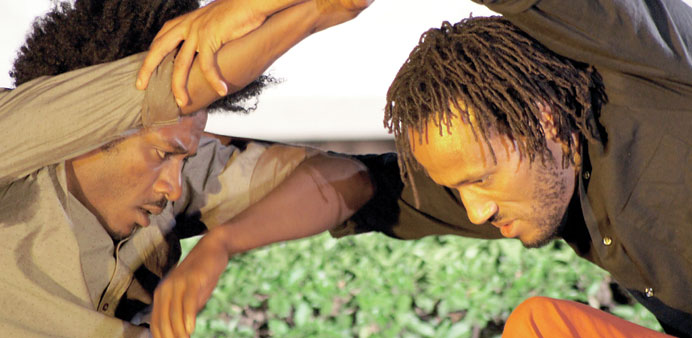
Junaid Jemal (left) and Addisu Demissie during a performance in the French Cultural Institute in Addis Ababa.
By Carola Frentzen
Ethiopia’s biggest contemporary dance company has transformed street children into professional dancers who now enjoy international recognition and have been freed from the grinding poverty of their upbringing.
Supporters of the project say the 18 young dancers from the Adugna Dance Company are living proof that human and social development must go hand in hand.
“Adugna” means “luck” or “chance” in the Amharic language and the company, which started as an experimental project in the streets of Addis Ababa, has grown into something of an international phenomenon over the past 15 years, impressing audiences across the globe.
British choreographer Royston Maldoom has played a major part in this success as one of the founders and most important supporters of the Adugna Dance Company.
“It was the difficult project,” remembers the 69-year-old, who spent significant parts of his career working with Ethiopia’s youth.
Maldoom is known for his involvement in the film Rhythm is it!, an account of a music-education project undertaken by the Berlin Philharmonic Orchestra under Sir Simon Rattle.
The objective of that particular project was to popularise classical music by staging a performance of Igor Stravinsky’s ballet The Rite of Spring with a cast of 250 children recruited from Berlin’s low-income public schools.
The situation in Africa is very different and Maldoom, together with his artistic assistant, Irish dance instructor Mags Byrne, had to first earn the trust of the youths. “The street children had no concept of what the future meant. Their ambition was limited and completely focused on the present,” explained Maldoom. “Their only concern was to raise enough money to survive — and not be exploited or abused on the streets of Addis Ababa.”
Initially, around 100 children from the slums of the metropole were chosen to take part in a performance of Carmina Burana at the city hall. Maldoom and Byrne immediately realised that there was a lot of potential hidden among the mud huts of Addis Ababa.
With the help of the Ethiopian aid organisation Gemini Trust, the pair invited 18 particularly talented children to take part in a five-year experimental programme. The majority of the participants came from impoverished families which had at least one pair of twins.
The children learned dancing techniques from different countries as well as the usual school subjects such as mathematics and English. They also studied acting, martial arts and yoga. The training culminated with the awarding of a British higher-education diploma.
Addisu Demissie was 14 years old when he began his training as a professional dancer in 1996. Demissie had left school four years earlier and earned his living cleaning shoes in one of the Addis Ababa’s largest hospitals.
Junaid Jemal was just 11 years old and had received very little formal education when he got involved in the project, having previously survived by selling handkerchiefs.
“We said to ourselves that this was an opportunity that we had to advantage of,” explains Demissie as he stretches his legs prior to a performance in the French Cultural Institute in Addis Ababa.
The pair have performed all over the world, including London’s Royal Albert Hall, but they still practise in an empty office belonging to the Gemini Trust. “Ethiopian Fusion Contemporary Dance” is how they describe the style of dance, which incorporates elements of modern dance with traditional steps from their homeland.
However, the rotations and lifts involved in their routines are alien to their compatriots, who prior to the arrival of Adugna were only familiar with ancestral dances involving dancers wearing historical costumes.
Today, the venues are regularly sold out whenever the seven original Adugna members still living in Ethiopia perform in the capital.
The group has also earned a reputation for giving something back to their community by working as dance instructors for the poor, disadvantaged, HIV-positive and aged population of Addis Ababa.
This involvement led to the creation of the ‘Adugna Potentials’ — a group of nearly a dozen disabled dancers who have performed to rapturous audiences across the city.
“I am now 31 and want to dance less over the coming years and instead share more of the knowledge I have gathered,” says Demissie, who together with Jamal wants to open a new Adugna dance school based on the project’s original format in the coming weeks.
The idea is that 12 young people from impoverished backgrounds will spend three years learning to become professional dancers in order that modern dance continues to prosper in Ethiopia. “It would be terrible if this great project died with us,” says Demissie. — DPA