


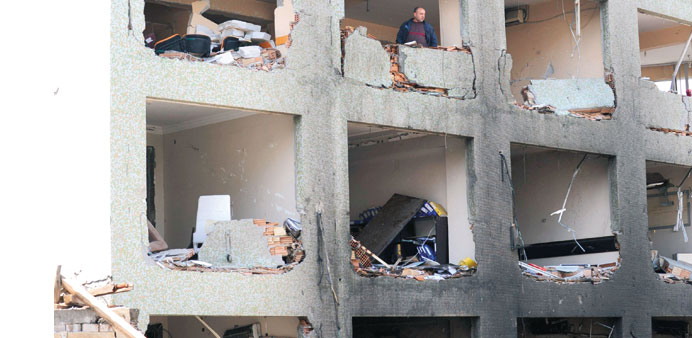
A man standing in a damaged building at Reyhanli in Hatay, just a few kilometres from the main border crossing into Syria. Turkey yesterday recovered the bodies of two more people killed in the twin bombings near the Syrian border town, pushing up the death toll to 48 as many others remained missing. The bodies were found in a sewer near the blast zones in the southeastern border town two days after twin car bombings which Ankara blamed on a radical Marxist group affiliated with the Damascus regime.
By Fulya Ozerkan/Ankara
The deadly blasts that shook Turkey at the weekend will only spur Ankara to press harder for global action against the Syrian regime, analysts say, as fears grow that the country is being dragged into the spiralling conflict.
At least 48 people were killed on Saturday in twin blasts in the town of Reyhanli, near the Syrian border, in an attack Turkey claims was masterminded by a group linked to embattled Syrian President Bashar al-Assad, though Damascus rejects the allegation.
The bombings were the deadliest incident on Turkish soil since the start of the Syrian civil war two years ago, in what observers see as a sign of the growing regional impact of a crisis that has already cost 80,000 lives.
With the Reyhanli bombings coming just days before Prime Minister Recep Tayyip Erdogan is to meet with US President Barack Obama in Washington on Thursday, the Turkish premier is likely to use the incident to urge the powerful Nato ally to take “a stronger stance” against Assad, said Soner Cagaptay of the Washington Institute.
“Even if the president is not ready to move on all (demands)... greater commitment to support the (Syrian) rebels would be well received in Ankara, as well as stronger US and Nato commitment to Turkey’s defence,” he said.
The bombing appeared in line with the “usual tactics and the capability” of Damascus, but Turkey would not resort to unilateral military force as an immediate reaction to avoid regional tension, Faysal Itani of the Atlantic Council told AFP.
“That Turkey was able to formally accuse the Syrian intelligence services indicates however that they are ready to use this bombing to pressure the US to adopt a more aggressive policy against the regime,” he said, “at least through military support for the rebellion.”
Turkey’s Foreign Minister Ahmet Davutoglu has said that the Reyhanli bombings had crossed a “red line”, while Erdogan - an outspoken critic of Assad - has urged his countrymen not to fall for Damascus’s attempt to drag them “into the Syrian quagmire”.
Ankara broke ties with Damascus soon after Assad, a one-time ally, launched a brutal crackdown on pro-democracy protests in 2011.
Since then, Turkey has become a rear base for Syrian rebels fighting to topple Assad’s regime, as well as a refuge for some 400,000 Syrian refugees, a heavy burden that is straining Turkey’s resources.
It has also been the occasional victim of cross-border shelling from Syria, with one incident in October killing five Turkish nationals.
In response, the US, Germany and the Netherlands in January deployed Patriot missile batteries along Turkey’s volatile border with Syria to serve as a deterrent.
But Erdogan wants Washington to go further and take the lead on robust action against the Syrian regime. He has also called for US support to establish a safe-haven and a no-fly zone inside the conflict-ridden country to protect rebel-held border territories.
A Turkish official, speaking on condition of anonymity, said the Reyhanli attacks had proved to the world “how merciless the regime is”.
“They show how urgently a solution is needed,” he said.- AFP
Syrian refugees fear backlash
Syrian refugees in Turkey say they fear a backlash after car bombings that killed 48 people and wounded many others over the weekend in the border town of Reyhanli.
“We are putting our trust in God but our fear is that people will blame us for the bombings and will attack us. We have to protect ourselves,” said 75-year-old Mohamed Nuh, one of thousands of Syrian refugees living in Reyhanli. “We haven’t been into the town centre since Saturday. Only out to the local shop. Other Syrians here won’t even leave the house,” said Nuh, who left Aleppo two months ago.
His grandson, Amr Nuh, 21, said he was out buying mobile phone credits when the blasts took place, and was seized by locals because he was Syrian. They held him and called the police who kept him overnight for questioning.
Since the attacks, some locals have turned their ire on the influx of Syrians in the town. A retired tailor who gave his name as Mehmet, 75, said anger was focused not at genuine civilian refugees but at rebel fighters who had taken advantage of hospitality in Turkey and were operating in the area, making it a target. “A Syrian family lives there,” said Mehmet, pointing to an apartment. “It makes me sad: they are too scared even to come out now. I have nothing against these people. But the other people, we just don’t know who they are.”