


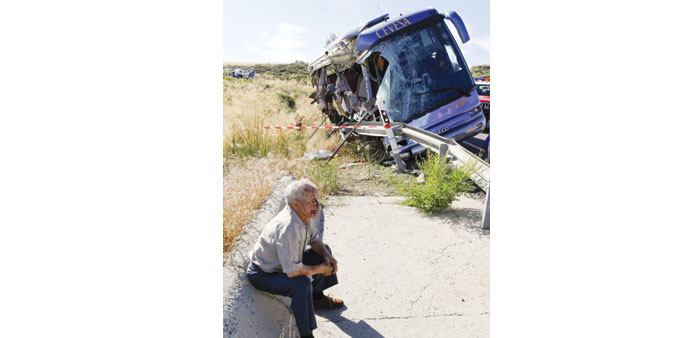
An injured passenger sits at a verge after a bus crashed at N-403 road near Tornadizos town.
AFP/Tornadizos de Avila, Spain
A bus carrying more than 30 passengers careened off a central Spanish highway and ploughed into a metal safety barrier yesterday, killing nine people in an impact that blew out windows and tore away one side of the vehicle.
Another 22 people were injured, five of them seriously, when the bus came off the road as it travelled downhill on a winding road near Avila northwest of Madrid, trapping several passengers in the wreckage, emergency services said.
The blue bus, which carried the markings of a private company, Cevesa, ended up nearly on one side, a buckled safety barrier preventing the vehicle from sliding further down a slope by the road.
Windows on the entire right-hand side of the bus were torn away and the buckled frames left exposed.
The broken bus windscreen hung open like a curtain.
“Nine people have died and 22 have been injured,” said a statement by the emergency services for the region of Castile and Leon.
A dozen ambulances, two medical helicopters and teams of firefighters converged on the scene.
Six bodies lay on the N-403 road, covered in white sheets or shiny gold and silver foil.
Emergency services workers in black helmets and tunics carried one person away on a stretcher. Shocked passengers sat on the kerb nearby, some being comforted by first aid personnel.
A female rescuer in white shirt and bright-orange vest could be seen placing a neck brace on a man lying on a yellow stretcher on the roadside, images relayed on Spanish media showed.
The bus had been heading to the provincial capital Avila from the province’s southern town of Serranillos and was less than 10km from its destination when disaster struck about 8.45am.
“It came off the road for unknown reasons,” said the central government representative for Avila, Ramiro Ruiz Medrano.
“They are investigating the possible causes at the moment,” Medrano told Spanish public radio. “There are some with very serious injuries, others are in shock.”
The driver was uninjured, Medrano said, though Spanish media said he was in shock.
The vehicle’s insurance papers and road worthiness certificates were in order, he added.
The injured were taken to hospitals in Avila for treatment or to be checked, emergency services said.
One six-year-old girl was flown about 100km by helicopter to a major hospital in Salamanca.
“She is stable but they have to examine her for trauma to the brain,” the mother, who was not named, told Spanish public radio.
A team of psychologists was comforting the victims’ families, who were taken to the Avila sports stadium.
A tow-truck later carted away the ruined shell of the bus.
Nearby, police directed traffic and searched in the long grass beside the road where the metal barrier lay squashed.
It was the deadliest bus accident since April 2008 when nine Finnish tourists were killed in a crash in southern Spain’s Andalusia region.
That accident was blamed on a drunken, speeding driver of a four-wheel-drive car who tried to overtake but hit the safety barrier and then collided with the bus.
In the last major bus accident in Spain on July 31, 2009, six Dutch tourists were killed and 39 injured when their bus overturned on a motorway curve near the northeastern city of Barcelona.
More recently, a dozen German tourists were injured August 11, 2011 when their tourist bus hit a wall in Manacor on the Balearic Island of Mallorca.