


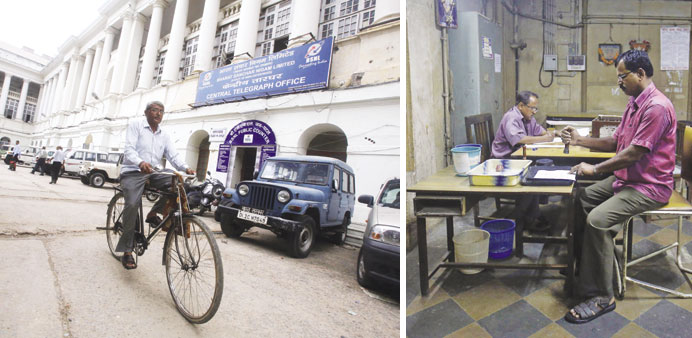
An employee, Om Dutt, 56, on his bicycle as he leaves the telegram office to deliver telegrams at Central Telegraph Office in New Delhi. The 160-year-old telegram services in India are to be discontinued from Monday due to declining revenues even after Indian government had revised the telegram charges in May 2011. Right: An employee stamps a telegram inside the delivery section room of the Central Telegraph Office in Mumbai.
By Sunrita Sen /New Delhi
If you have an old telegram, store it as a museum piece. On Monday, the Indian government is to end its 163-year-old telegram service.
Just a few decades ago, urgent news such as births and deaths and congratulatory messages for weddings and anniversaries would move across India in strips of paper pasted on a sheet, the words all in urgent-looking block capitals.
“The telegram service has lost its relevance with SMS, faxes and e-mails,” an official of India’s state-run telecom company Bharat Sanchar Nigam Limited (BSNL) said.
“Not many people use it any more and the service is no longer commercially viable.”
Estimated to be incurring losses of around Rs2bn ($33.5mn) annually from its telegram services, BSNL announced in June that it would be closing down the service.
About 1,000 employees work in telegraph offices across the country. “All employees would be shifted to other services like landlines, mobiles and broadband. There will be no lay-offs,” the BSNL official said.
Employees’ unions have objected to the closing down. “It is a valued service and should be kept as a skeleton service and preserved as a heritage,” former convenor of the Forum of BSNL Unions, V A N Namboodiri was quoted as saying.
Until telephone services improved in the 1990s, telegrams were the fastest way of communication in emergencies, especially in remote areas. Even today, soldiers posted in remote areas use telegrams to communicate with their families.
But with improved telephone lines, cheaper rates for calling long distance and the introduction of the mobile phone, the relevance and with it the popularity of the telegram service has waned.
Younger Indians already view it more as heritage. “I used the form a couple of times for projects at school,” said Ravi Saxena, 30. “I don’t think any of my friends have ever used it. Who would want to send a telegram when you can SMS from a mobile phone?”
The system can seem antiquated now. You could choose to write a short crisp message or choose from a number of pre-set messages, such as HAPPY DIWALI GREETING, number 4 on many Indian handsets.
One of the most frequent telegram messages was FATHER SERIOUS - which meant he was critically ill or, perhaps, dead. Nicer messages, like CONGRATULATIONS ON YOUR WEDDING or CONGRATULATIONS ON NEW ARRIVAL came in a more gaily printed form.
News reporters before the era of e-mails and faxes would send long telegrams to their headquarters, which were then painstakingly retyped, and completed with real punctuation instead of the characteristic word STOP to end sentences.
India’s first telegraph message was transmitted between the eastern city of Kolkata, then Calcutta, and the town of Diamond Harbour, 50km south, on November 5, 1850.
By 1853, telegraph lines connected Kolkata with Peshawar, Agra, Chennai, Mumbai, Bangalore and almost all other major towns across the country.
Initially the service was used by the British East India Company, and in 1854 it was opened to the public.
Telegrams played an important role for years in the personal life of Indians, but also in official communications.
Historians say the telegram played a crucial role in India’s first war of independence, or the Sepoy Mutiny, in 1857 with the British colonial rulers able to clamp down quickly on the rebellion thanks to information moving fast through telegrams.
Over the years, BSNL modernised the system and today messages are fed into a computer and the prints are delivered by postmen.
BSNL also hiked the price of a 50-word telegram from Rs4 to Rs50 in 2011, the first price revision in 60 years, but it seems there were still not too many takers.
“Currently, we send only about 5,000 telegrams per day,” the DNA newspaper quoted a BSNL official as saying. “That’s down from several hundred thousand a day before the advent of the fax machine.” Most of these telegrams are sent by government departments.
So its time to bid adieu to a service that set many hearts bumping with anticipation at the sound of the postman knocking at the door and saying the one word, “telegram”.
The last telegram to be sent on Monday may be preserved in a museum, India’s telecommunications minister Kapil Sibal has said. - DPA