

Guardian News and Media/London
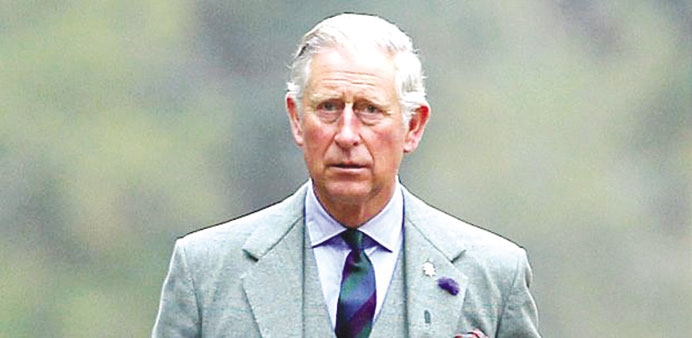
MPs will question Prince Charles’s most senior aide today over controversial tax arrangements that underpin the heir’s £19mn annual income.
After investigations into alleged tax avoidance by Amazon, Google and Starbucks, the public accounts committee wants to know why Charles’s hereditary estate, the Duchy of Cornwall, does not pay corporation tax or capital gains tax and why Charles only pays income tax voluntarily on his earnings from the £847mn property empire.
Last year he offset almost £11mn against official expenditure before paying a higher rate tax on the rest.
The House of Commons hearing will take evidence from William Nye, Charles’s private secretary; Keith Wills, the finance director of the Duchy of Cornwall; and Paula Diggle, HM Treasury’s officer of accounts.
It represents the most intense scrutiny yet of Charles’s historic tax status, which has faced increasing challenge in the last year.
Tax campaigners and anti-monarchy groups argue that the rationale for a special arrangement by which the duchy is not taxed and Charles pays tax voluntarily is unjustified, a claim Clarence House and the Duchy of Cornwall strongly deny.
The hearing comes as details emerged of a unique tax arrangement to deal with the proceeds of Charles’s partnership in a Dorset energy firm that he and the Duchy helped set up with a group of farmers to extract methane from potato peelings and other biowaste.
Charles is a partner in JV Energen, which describes itself as the UK’s first commercial-scale anaerobic digestion and biomethane injection plant.
The joint venture is based on duchy land and is set up as a limited liability partnership, a vehicle that requires partners to pay their own income tax or corporation tax and capital gains tax on profits and proceeds in the normal way.
While Charles is the named partner using his Duke of Cornwall title, he will not directly face those taxes because the duchy holds the 54% share does not pay capital gains tax or corporation tax.
Any profits accruing from Charles’s partnership will contribute to the duchy’s surplus on which Charles pays income tax on a voluntary basis and after the deduction of expenses for official business.
The plant opened in November and did not make any capital gains or trading profits in the year 2012-13.
Clarence House said Charles would pay income tax on any surpluses at the highest rate, albeit after expenses were deducted.
It also said any capital gains would, by law, have to be reinvested in duchy assets and so no capital gains tax should be paid.
“As with all duchy investments, any trading profits would form part of the duchy surplus, upon which the Prince of Wales pays the highest rate of income tax (after the deduction of business expenditure),” a spokeswoman for the duchy said.
“The prince is not entitled to receive any capital gains from the duchy, and therefore does not pay capital gains tax.”
The public accounts committee chairman, Margaret Hodge, said she would raise the arrangement during today’s hearing.
Graham Smith, chief executive of Republic, the campaign for an elected head of state, which alerted the committee to the JV Energen arrangement, said: “We have long known that Prince Charles enjoys a privileged tax position with regards to the Duchy of Cornwall but the extent of this exemption is increasing to new areas of activity.
“Had Prince Charles invested his own money and not used the title Duke of Cornwall he would have been liable to tax in the normal way. Isn’t it astounding he chose not to do that in this current climate? He could have opted into tax, but he opted out.” This month the duchy defended the prince’s tax arrangements after a Channel 4 Dispatches investigation. “The Prince of Wales chooses to use his income from the duchy, rather than public money, to cover the great majority of the cost of the public duties of both himself and the Duchess of Cornwall, as well as the Duke and Duchess of Cambridge and Prince Harry,” it said.