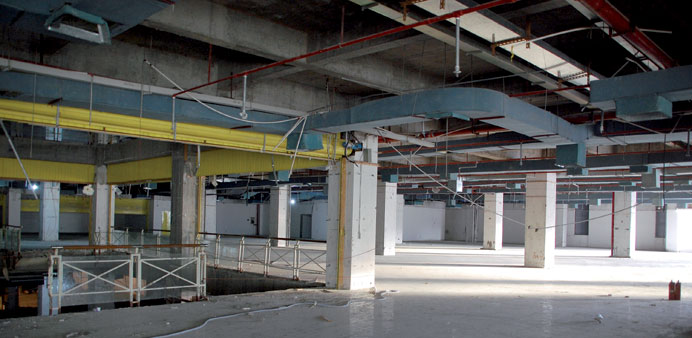

A section of the New South China Mall, which remains unfinished, years after the complex was erected.
By Stephan Scheuer
The steps echo in the long, empty corridors. In many places the ceiling has collapsed. At the opening in 2005 the New South China Mall in the southern Chinese city of Dongguan was described as the biggest shopping centre in the world. But today large areas of it are like a derelict ruin.
The biggest, the widest, the tallest: across China politicians boast of ever more mega-buildings. However, the reality is often not so rosy. In many places former prestige projects are crumbling away. The mall in Dongguan has become a symbol for the misguided projects of China’s provincial politicians and developers.
“Local governments want to boost their economy with the buildings. In my opinion that is not right and is unhealthy for economic development,” Cheng Min from the East China Research Institute for Architecture and Design said.
While investors backed such buildings, ultimately the decision to approve their construction lay with provincial authorities. Regional politicians sought to boost their own image by being associated with mega-buildings that often served egos rather than the people.
“Careful, that’s all in danger of collapse,” a security guard warns. Several parts of the New South China Mall were poorly constructed. “It’s a shame,” he says. “All of China knows us only as the failed project.”
Four years after the opening the operators have had to admit on state media that 99% of the centre is empty. Today a PR agency in Beijing employed by the operators claims that the vacancy rate is just 17%.
However, the picture on the ground is very different.
High-rise buildings, shopping centres and bridges: the list of gigantic projects is long. Recently the central Chinese city of Changsha hit the headlines when it was announced that the world’s tallest skyscraper would be built there.
The 838m “Sky City” was supposed to be built in just seven months. Around 1,000km further east is the city of Chengdu where a new record in width rather than height has been achieved.
The New Century Global Centre is only 100m high but at half a kilometre long and 400m in depth it is by surface area the largest building in the world.
But opposition to Chinese provincial politicians’ love of huge and spectacular buildings is growing. It has been reported that town planning authorities have stopped the building of the colossal skyscraper in Changsha for the time being because of missing approvals, although the developer has denied this.
Meanwhile, the party newspaper People’s Daily criticises the “rabid addiction” to mega projects in many cities while slums still exist. The central government has often called for balanced growth, but it now seems to be no longer willing to turn a blind eye to what’s happening in the provinces. At the end of July it announced a five-year freeze on the building of new office buildings.
“I feel good when I see well-built facilities that serve the citizens,” said state and party chief Xi Jinping. “But I feel bad when I see a huge office building.”
Journalists in the state-controlled media have also been encouraged to denounce senseless mega-projects. The east coast province of Zhejiang opened in July a 10.1km-long cable-stayed bridge that the operator claimed is the longest in the world. But not all media outfits joined in the jubilation over the project.
One pointed out that within 50km, there are already two other bridges over the bay as well as a tunnel under it.
As the business newspaper Diyicaijing reported, “Every one of these provincial politicians only looks to his own advantage.” – DPA