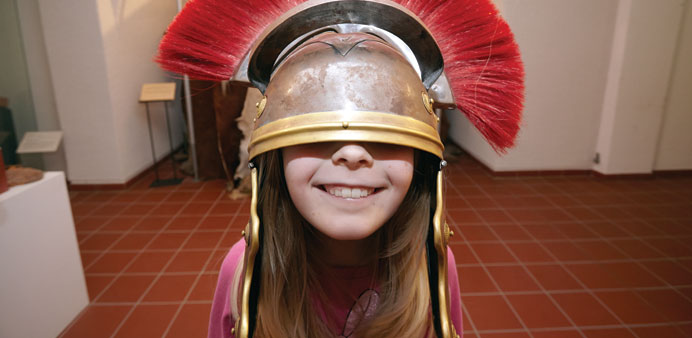

A German primary school girl tries out the brightly adorned helmet of a Roman legionary and finds it far too big at the State Museum in Koblenz.
By Christian Schultz
Nico carefully examines the medieval chain mail and gauntlets before putting them on. “It’s very heavy,” says the 10-year-old schoolboy as his classmates look on in wonderment, laughing as Nico is transformed into a medieval knight.
The school group is on a visit to Ehrenbreitstein fortress, a huge 19th century German military citadel that is home to the Koblenz regional museum.
The dusty glass display cases so common in museums of this kind are nowhere to be seen as the children enjoy a hands-on experience of what life was like for people living in the Middle Ages. Instead, they are actively encouraged to touch and try out the exhibits.
There is much to explore and discover at the “Hands-On” exhibition curated by museum educator Joerg Hahn. The children learn about the difficulties of milling corn before the advent of electricity, what it felt like to walk in sandals with nailed soles and how uncomfortable life was living in a yurt — a tent-like home — in Ice Age Europe.
The exhibition covers around 800,000 years of human history, stretching from the early Stone Age to the Middle Ages. “The children come to life in here,” says Hahn. Comprehension through touch is the founding principle of the project.
Using a pointer painted blue at the tip, Hahn explains human development to his young listeners, concentrating on how small episodes influenced the whole of human history.
Distractions and shrieks all have been taken in their stride.
A young boy marches through the room waving a sword and doing goose-steps. “Left march, two, three, four,” he chants before exiting.
The Hands-On museum opened its doors in 2006 and has been growing exhibit by exhibit ever since. It is specifically aimed at youth and schoolchildren but can also cater for blind groups and is open to all-comers on specific action days during the year, explains Hahn.
There are currently around 150 objects on view, consisting of a mixture of original artefacts and accurate reproductions. The exhibits include a Stone Age mill, helmets, weapons and a curule chair, which is something like a modern-day camping stool but was a medieval badge of power, explains Hahn as he stands beside a Roman dining couch replete with a bowl of grapes.
“An 11-year-old once reclined on it and observed immediately how powerful he felt,” recalls Hahn with a smile.
Like her students, elementary schoolteacher Sandra Weber is also a big fan of the exhibition. “Everyone is having a wonderful time,” she says.
Weber had previously tried to explain medieval life to the children in the classroom but the museum has helped the youngsters gain a deeper insight into the period. As she finishes talking, Weber is suddenly surrounded by a group of children dressed in Celtic attire. “Tell her not to give us any more homework,” cries one junior warrior.
As usual, the tour ends with a visit to the musuem’s workshop where each child makes their own marionette from paper and cloth. Calm only returns when the children have boarded their bus and departed.
“Nobody has ever left here thinking it was boring,” says Hahn. The objective is for schoolchildren to understand that museums can be fun. “It’s a wonderful feeling when they come up to me and say that they want to come here again.” – DPA