


|
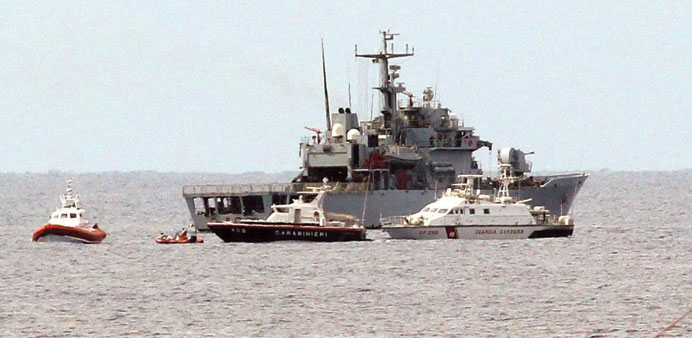
If there is one thing everybody in Europe agrees on after the deaths of around 200 migrants off the Italian coast last week, it is that something needs to be done. |
But what that should be is already shaping up to be a bone of contention, as European Union interior ministers prepare to debate the issue today.
Migration has long been a touchy matter in Europe, which remains a prime destination for those seeking a better life. In 2011, there were some 1.7mn immigrants to the European Union, according to statistics agency Eurostat.
“There are more people on the move today than at any other time in recorded history,” William Swing, the director general of the International Organisation for Migration, noted last week during an event organised by the Council on Foreign Relations.
And yet, at the same time, you often have “sort of a wave, a tide of anti-migrant sentiment, tighter visa regimes, closing borders, building walls, making it very difficult for human mobility to take place”, he said.
Italy is, for now, only demanding assistance from the European Union to cope with the renewed influx of migrants arriving from the conflict-plagued Middle East and North Africa.
“Europe is at a crossroads: it must choose if it really is a union of states,” Interior Minister Angelino Alfano told the Italian parliament last week. “The Mediterranean represents the Africa-Europe border, not the Africa-Italy border.”
“(The Lampedusa incident) is a huge tragedy, the biggest linked to migration in the history of Sicily, and what hurts the most is that Europe is a bystander,” the mayor of Lampedusa, Giusi Nicolini, wrote in an open letter. “Municipalities like ours cannot be left alone on the frontline.”
According to official figures, 30,100 would-be asylum-seekers arrived by boat in Italy in the first nine months of 2013, compared to less than 8,000 during the course of 2012.
The numbers are still well off from the more than 62,000 arrivals by sea that the country recorded in 2011 - at the height of the Arab Spring pro-democracy protest wave - but Alfano says Italy needs assistance now.
He has called for the EU to step up patrols on the Mediterranean and for its northern members to take in more asylum-seekers.
But there is little appetite in the 28-country bloc for dramatic migration reforms, particularly when it comes to the so-called Dublin rules, which force asylum-seekers to apply for protection in the first country of arrival.
“Definitely, we’re not speaking about Dublin. Dublin is closed,” one EU diplomat said last week, speaking on condition of anonymity.
When asked about other possible action fronts, EU officials point to the need for progress on the EUROSUR border surveillance system; on partnerships with the countries that migrants leave behind or travel through; and on action against human traffickers.
“Migration reduces poverty on an extraordinary scale. We need more channels for legal migration,” EU Home Affairs Commissioner Cecilia Malmstrom said last week.
Non-governmental organizations have called on the EU to set up “humanitarian channels” allowing asylum-seekers to cross the Mediterranean safely.
“With legal channels of entering the EU for protection reasons almost non-existent, most refugees have no choice but to risk their lives in order to try to reach safety,” the European Council on Refugees and Exiles noted. “This has to change.”
The possibility of more EU funding for Italy has also been floated, although officials point out that the country already is among the largest recipients of migration support - with around 138mn euros ($187mn) earmarked for it this year.
At the same time, Italy is not among the European countries that take in the most asylum-seekers, critics are quick to point out.
In 2012, it recorded 15,715 asylum applicants. Austria, Belgium, Britain, France, Germany and Sweden all had more, with Germany topping the list at 77,540 applicants, according to Eurostat.
And yet, the EU cannot be seen to remain passive - especially with 2014 European elections looming.
The European Commission announced yesterday that its president, Jose Manuel Barroso, would be visiting Lampedusa tomorrow “in the spirit of European support and solidarity”.
But expectations are low that ministers will deliver significant action today.
“It will be the beginning, the kick-off of a further process,” the EU diplomat said.