


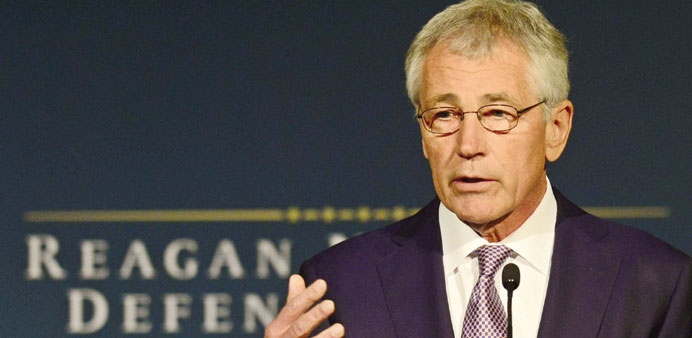
Chuck Hagel: “These cuts are too steep, too deep, too abrupt”
Defence Secretary Chuck Hagel sounded an alarm bell on Saturday about budget cuts he said threaten America’s security and global military role, while “gambling” over the risk of an unexpected threat.
The cuts, which amount to nearly $1tn for the Department of Defence over a decade, were “too steep, too deep and too abrupt,” Hagel told a defence conference in California.
“This is an irresponsible way to govern, and it forces the department into a very bad set of choices.”
Automatic cuts of $52bn set to take place in fiscal 2014 represent 10% of the Pentagon budget.
The Navy’s global presence is already down 10% since sequestration began in March, while the Army has cancelled training rotations for 15% of its forces and the Air Force 25% of its training events.
“The effects will be felt for a long period of time to come. By continuing to cancel training for non-deploying personnel, we will create a backlog of training requirements that could take years to recover from,” Hagel said.
“These cuts are too steep, too deep, too abrupt.”
The defense chief was speaking at the Ronald Reagan Defence Forum, a one-day event hosted at the late US leader’s presidential library northwest of Los Angeles.
The Pentagon has made clear to Congress and the White House “the growing difficulties we face in training, equipping and preparing our forces under a cloud of budget restraints and uncertainty,” Hagel said.
“These challenges are often not visible, but they are very very real, and they will become more visible as they further jeopardise the security of our country as our readiness, capability and capacity continue to deteriorate.”
The budget crisis comes as the US military is drawing back after more than a decade of war in Iraq and Afghanistan following the September 11, 2011 attacks.
But Hagel warned that if a deal is not reached to stave off the deepest cuts, US forces might not be ready if another major conflict erupts unexpectedly.
“If sequester-level cuts persist, we risk fielding a force that is unprepared,” he said.
“In effect, we would be gambling that we will not face a major contingency operation against a capable adversary in the near-term.”
The sequester was devised as a poison-pill austerity programme in 2012, with mandatory cuts spread over 10 years aiming to force battling Republicans and Democrats to compromise on a long-term program to reduce the country’s deficit.
But a deal never came and the White House was forced to lop $85bn from spending between March and the end of the fiscal year on September 30, with nearly half of that from defence programmes.
Hagel’s predecessor Leon Panetta also made no bones about the crisis facing the US military, in a panel discussion shortly preceding the current Pentagon chief’s closing speech.
Panetta said the cuts would impact “almost in every area where we have been able to respond, whether it’s military crisis, whether it’s a need to go in and try to rescue people, whether it’s the need to do a bin Laden operation.”