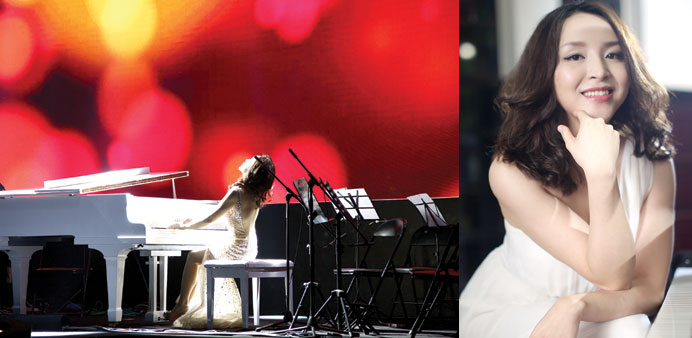

ARTISTE AT WORK: Chen Jie performing at Katara, wearing Qatar’s rising designer Wadha Al-Hajri’s latest collection. RIGHT: WHAT NEXT? Chen Jie laughs, and says marriage, perhaps!
By Umer Nangiana
The handshake is soft, but there’s no mistaking the magic those fingers have weaved over a piano. As I’m soon to discover, the notes have a flourish, and they resonate all around us.
The piano chose her, not the other way around, Chen Jie tells me with compelling ease, and that she “never disappointed it”.
The dynamic Chinese pianist, recently chose Doha as the gateway to the Arab world, and the people, to her delight, responded with warmth.
So enthralled by the audience’s response to her performance at Katara was the 28-year-old internationally acclaimed artiste that she decided to look into the possibility of a collaboration with Arab musicians.
“I found Arabic music very improvisational. It is very individualistic as well. Everyone has a different tune and I loved it,” Chen told Community in an interview.
Before her likely return to Doha in February next year, Chen would explore ways to find collaborations here, she said.
The star wants to be an ambassador of culture not just a performer. “Culture is the key to open people’s hearts and once we have opened peoples’ hearts, this world would be a better place to live in,” enthused Chen.
The pianist feels picking Qatar as the first choice to enter the Arab world was down to fate. “I always believe that sometimes you do not decide where you go, life decides for you,” Chen said, adding that she wished she could speak some Arabic.
Her performance at Katara was one of her most memorable ones. “I was afraid it was the first time they were going to listen to some Chinese music so I would probably not be able to keep their attention but it was great,” Chen said. “As artistes we can make out if the audience is with us or not and I could totally feel that they were with me,” she added.
Sharing her experiences of performing before other audiences, the pianist said reactions in different countries have been different but interesting.
“For instance, in general, German audiences I would say are a wee bit cold but they listen with great attention to detail, brooking no noise,” she said. “American audiences, on the other hand, go “Bravo!” — you know everyone is like, “Bravo!” (smiles). Spaniards are also very warm,” she added.
Trained by maestros such as Seymour Lipkin and Claude Frank at The Curtis Institute of Music in Philadelphia for eight years, Chen made her orchestral debut with Wolfgang Sawallisch, one of the piano greats, at the age of 16 with Philadelphia Orchestra.
She went on to make her solo recital debut in Carnegie Hall at 18 and released her first album at 19. Sharing her memories with Community about the time spent at Curtis and her first performance, Chen said it was the best in her life.
“I thought I was going to be super nervous but I was not. I do not know what happened to me. I was 16 years old and playing with Wolfgang Sawallisch, I mean just imagine!”
But it was her practice that made her enjoy her first big experience. At Curtis, Seymour Lipkin, her first teacher, she said, was very strict but he trained her to work hard. Later, she drew inspiration from not just one but many artistes.
“I love to see paintings, I love to see dancers and I get inspiration from many different aspects,” Chen told Community.
So how did she get into playing the piano?
One day in her kindergarten class at the age of three, she heard a piano tune on a radio broadcast. She climbed the stool in front of the piano in her class and played the same tune on it.
Her class teacher conveyed this to her mother. “The teacher told my mother, “Oh! She has talent,” said Chen, recalling how her parents then supported her in pursuing a career as a pianist.
It was her mother who pushed her to go to Curtis, where her entry was also dramatic. She got the visa just a day before her audition and arrived on the day of audition at the institute.
“I couldn’t get a wink of sleep — went directly to the audition, played and passed,” recalled Chen.
“I always feel the piano and music chose me. No-one in my family has had any association with music before me,” she pointed out. Her training at Curtis turned her into a solid performer. She used to practice eight hours a day. “Now I need only a couple of hours to get ready for a performance,” Chen hastens to add.
After making her orchestral and solo debut, the artiste decided to make a shift to Chinese music from Western. The idea came to her on one of the days during her travels for concerts worldwide.
“One day, I was lying in a hotel and thought to myself: is this how I am going to spend my life, always playing western works?” Chen told Community.
“I feel music is a language and I thought I would like to use English language to tell people the story of my own country,” she added.
Her first album was entirely dedicated to Chinese music. She said it fared better than she had expected. Initially, she feared people might fail to understand it. But the album received great reviews. This encouraged her to go for her second album which featured her first ever composition Butterfly Lover.
Chen has won many prizes and awards during her career which include the ‘Arthur Rubinstein Piano Master’ in Israel, the Piano-E-International’ in Minnesota, ‘The Washington International Piano Competition’, the ‘Van Cliburn in America’ in America, the ‘Santander Paloma O’Shea’ in Spain, the ‘Villa-Lobos’ in Brazil and many others.
She has given solo recitals in the Lincoln Center in New York, the Kennedy Center in Washington DC, the Herkulessaal in Munich, The Louvre Museum in Paris, the Ravinia Music Festival in Chicago, the Forbidden City Music Hall in Beijing, the Tokyo Opera House and others.
At the age of 24, she was chosen by America’s KDFC Classical Music Station as ‘2008 top 30 under 30’.
At one time she felt she was just winning too many prizes and did not wish to be labeled a “prize baby”. “Winning prizes, for me, is not the goal. It’s the beginning,” she said. The awards are good in providing a platform but ‘how to go about from there is more interesting and important to me.’
“I get to know the world through my musical journeys. I meet different people, I collaborate with them in a way that is my way of communicating with the world,” said Chen.
Besides being an avid performer, Chen also teaches music. She founded the music department at the University of Shanghai for Science and Technology and is currently serving as its director. The department took birth from her idea that technology, engineering and arts should go together.
“We had Steve Jobs because he had great artistic sense. He could turn something so cold into something very beautiful,” explained the pianist, adding that she wanted to tell young people that they should not separate arts from life.
The department, she said, was prospering where they ‘combine technology with classics.’
China, she said, was going through a cultural boom. More and more young people were studying piano but the master pianist felt the development was haphazard. Still, she was hopeful people would soon comprehend the meaning of music as society matures. Understanding the meaning of music is necessary. Learning success and learning music is not just the same, she emphasised.
“Music teaches you the value of life. It is not something you do for competition. It tells you how to appreciate life,” said Chen.
Piano is the most complete musical instrument. It can be romantic and very powerful. At the same time, it can be very aggressive or very calming. Chen said piano has everything which is why it is difficult. It offers the biggest range of keys. It has the loudest sound to the softest sound.
“For me, piano has the potential to do everything. You have a great selection of different moods to choose from,” she averred.
After achieving so much so early in life, what was she planning to accomplish next?
“Getting married (laughs). I think (pause) that is about it” chuckles Chen, again, as if on cue to provide a happy ending to the tete-e-tete.