


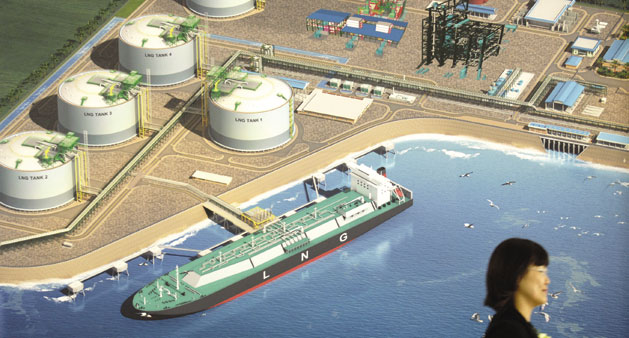
A poster showing the to-be-built first LNG terminal in Singapore (file). The city-state plans to build a second receiving terminal for liquefied natural gas as it pursues a long-term strategy to become Asia’s LNG trading hub.
Bloomberg/Singapore
Singapore plans to build a second receiving terminal for liquefied natural gas as it pursues a long-term strategy to become Asia’s LNG trading hub.
The city-state, which generates more than 90% of its electricity using natural gas, is studying locations in the eastern part of the country for a new facility to support industries and power plants, Prime Minister Lee Hsien Loong said on Tuesday at the official opening of Singapore’s first terminal.
Singapore is trying to take advantage of its geography and stature as Asia’s oil-trading centre to also become a leader in LNG. Asia has overtaken Europe as the world’s biggest gas importer, accounting for 46% of global trade, according to the International Energy Agency, which cites Singapore as best-placed to be the hub for liquefied natural gas.
“It is signalling a confidence that the government feels it can play a role in the regional LNG market,” said Tony Regan, a Singapore-based energy consultant at Tri-Zen International Inc. “Just talking about it is to capture the attention of the traders and say, look, Singapore’s serious.”
The Southeast Asian nation’s first terminal alone has capacity to handle about three times as much gas as Singapore consumes. The city imported its first LNG cargo in March 2013 to inaugurate its 3mn metric-tonne-a-year receiving facility on Jurong Island. A third tank has been completed, doubling capacity to 6mn tonnes, Lee said.
A fourth tank will be added at the original site, taking capacity to at least 9mn tonnes a year by 2017, the prime minister said. The terminal can accommodate as many as seven tanks with a total capacity of 15mn tonnes a year, he said.
The second LNG facility will probably have a similar maximum capacity as the first terminal and could be built as a floating facility offshore, Chee Hong Tat, chief executive officer of Singapore’s Energy Market Authority, said yesterday at a conference in the city-state. The prime minister’s announcement had no details on the timing or size of the proposed project.
“Just mooting the second terminal is very visionary. This is long-term planning,” said Regan, who expects the new project won’t be operating until 2025 or 2030. “It’s going to make sure it has enough capacity to play in the regional market, not just the domestic market.”
The second terminal may be used for reloading and ship bunkering rather than just for imports, said Leigh Bolton, managing director of Holmwood Consulting, who has 20 years of experience in natural gas and LNG.
“Do they need another terminal only for Singapore trading? I would say probably not because they are already expanding their existing terminal’s capacity,” Bolton said by phone from Surbiton, England.
LNG meets about 20% of the country’s natural gas needs, according to Sriram Narayanan, the commercial director at Singapore LNG Corp, which operates the Jurong Island terminal. The rest is supplied by four pipelines from Malaysia and Indonesia, according to the Energy Market Authority.
“We are preparing for the possibility that our demand for natural gas may one day be met entirely by LNG,” Lee said. BG Group won the contract in 2008 to supply 3mn tonnes of LNG to Singapore annually over 10 years starting last year. The company had committed 2.6mn tonnes a year by August 2013, it said on its website. A second license to supply the Asian city-state with 1mn tons through 2018 will be awarded by the Energy Market Authority.
Southeast Asia’s gas demand will rise 184bn cubic metres by 2018, up about 19% from 2014 levels, compared with 11% growth in global consumption, the Paris-based IEA estimated in its medium-term gas report in June last year. By contrast, China’s needs will increase by 56% to 294bn in the same period.
About 59mn tonnes of LNG, or 25% of the 236mn tonnes sold globally, were traded as short-term or spot cargoes in 2012, unchanged from the year before, according to an annual report by International Group of Liquefied Natural Gas Importers. Asia accounted for 71% of global demand. Companies have lined up to tap Singapore’s market. Germany’s EON SE, Glencore Xstrata Plc and others have hired LNG traders in the city. Qatar Liquefied Gas Co, the world’s largest producer known as QatarGas, is looking to expand in the region, Abdulla al Hussaini, the company’s marketing director, said in an October interview.
GAIL India will allocate 1mn tonnes of the fuel from the US for trading at its Singapore unit, Chairman BC Tripathi said in an interview on October 29.
Temasek Holdings Pte, Singapore’s state-owned investment company, set up Pavilion Energy Pte in April to trade LNG. Pavilion has a contract for 500,000 tonnes a year for 10 years starting in 2018 from an unidentified European supplier.
Spot LNG for Northeast Asia is trading near a record high. Prices for cargoes to be delivered over the next four to eight weeks were $19.60 per million British thermal units, Energy Intelligence Group said on February 17 on its website.