


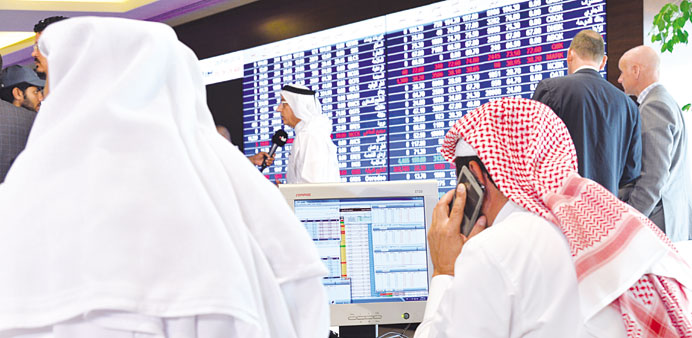
Al khaliji and Medicare Group will replace Alijarah Holding and Widam Food Company in 20-stock benchmark QE Index of the Qatar Exchange with effect from April this year.
The other barometers such as the All Share Index and the Al Rayan Islamic Index have maintained their status-quo in terms of constituents. But the Islamic index weightings would be restructured on the basis of ranking of a company’s liquidity adjusted capitalisation.
The other 18 entities in the QE Index will continue to be QNB, Industries Qatar, Ooredoo, Masraf Al Rayan, Commercial Bank, Qatar Islamic Bank (QIB), Qatar Electricity and Water, Doha Bank, Nakilat, Barwa, Milaha, Qatar Insurance, United Development Company, Gulf International Services, International Islamic, Qatari Investors Group, Vodafone Qatar and Al Meera.
A market analyst said Mesaieed Petrochemical Holding, although it has higher volumes, did not figure in the list for lack of long trading history.
Under the new index practices, a review is carried out twice a year to ensure that the selection and weighting of the constituents continues to reflect the purpose of the index.
The maximum weight a single stock can hold within QE index as of the rebalance date is 15%. If during the index review any stock is found to exceed this weight, then the stock’s market value is capped and any excess weight is distributed proportionately among the remaining index constituents.
The bourse has seven sectors - banks and financial services, insurance, industrials, real estate, telecom, transportation and consumer goods and services in the ‘All Share Index’.
Al Rayan Islamic Index constituents remain unchanged and they are IQ, Masraf Al Rayan, Barwa, QIB, UDC, International Islamic, Qatari Investors Group, Vodafone Qatar, Alijarah Holding, Gulf Warehousing, Al Meera, Qatar National Cement, Medicare Group, Widam Food, Mazaya Qatar, Zad Holding, Qatar Islamic Insurance and Qatar Industrial Manufacturing.
Shares slip below 11,400 as institutionals book profit
By Santhosh V Perumal/Business Reporter
The Qatar Exchange was back in negative trajectory yesterday to close below the 11,400 mark, mainly on institutional investors’ net profit-booking pressures.
Net selling was stronger particularly at the industrials, realty and transport counters in the bourse, whose 20-stock Qatar Index (based on price index) settled 0.27% lower at 11,388.14 points.
Small and mid cap equities largely bore the brunt of an overall bearish sentiments in the market, where trading volumes fell and overall it was skewed towards real estate, industrials and banking sectors.
The index that tracks Shariah-principled stocks was seen to gain, albeit at lower levels, in the bourse, which is up 9.72% year-to-date.
The 20-stock Total Return Index was down 0.05% to 16,838.36 points and the All Share Index (with wider constituents) by 0.04% to 2,912.18; while the Al Rayan Islamic Index was up 0.1% to 3,481.83 points.
All the three indices factored in dividend income as well.
Industrials stocks fell 0.78%, realty (0.57%), transport (0.4%), consumer goods (0.3%) and telecom (0.25%), whereas banks and financial services rose 0.64% and insurance 0.1%.
About 54% of the stocks were in the red with major losers being QNB, Mesaieed Petrochemical Holding Company, Gulf International Services, Nakilat, Barwa, Vodafone Qatar, Qatar Islamic Bank and Milaha.
However, Industries Qatar, Mazaya Qatar, United Development Company, Commercial Bank, Doha Bank and Masraf Al Rayan bucked the trend.
Market capitalisation fell 0.3%, or about QR2bn, to QR636.39bn. Small and mid cap equities lost 1.22% and 0.53% respectively; while large caps rose 0.28%.
Domestic institutions turned net sellers to the tune of QR35.46mn compared with net buyers of QR4.91mn the previous day.
Foreign institutions’ net selling was QR13.95mn against QR7.96mn on Tuesday.
Qatari retail investors’ net buying stood at QR43.08mn compared to QR1.17mn the previous day.
Non-Qatari individual investors’ net buying amounted to QR6.38mn against QR1.87mn on Tuesday.
Total trading volume was down 4% to 14.71mn stocks, value by 21% to QR619.89mn and transactions by 7% to 9,092.
The telecom sector’s trading volume plummeted 76% to 0.3mn equities, value by 55% to QR9.67mn and deals by 34% to 192.
The market witnessed a 43% plunge in industrials sector’s trading volume to 3.17mn shares, 41% in value to QR190.41mn and 23% in transactions to 3,844.
The consumer goods sector’s trading volume tanked 22% to 1.34mn stocks, value by 44% to QR57.59mn and deals by 43% to 783.
However, the transport sector’s trading volume grew about 19-fold to 1.11mn equities and value by eight-fold to QR30.63mn on about seven-fold jump in transactions to 531.
The banks and financial services sector reported a 58% surge in trading volume to 3.81mn shares, 17% in value to QR232.3mn and 49% in deals to 2,353.
The insurance sector’s trading volume soared 44% to 0.36mn stocks and value by 15% to QR15.6mn but on a 12% fall in transactions to 202.
Although the real estate sector’s trading volume expanded tanked 12% to 4.61mn equities, value declined 27% to QR83.7mn and deals by 4% to 1,187.
In the debt market, there was no trading of treasury bills and government bonds.