


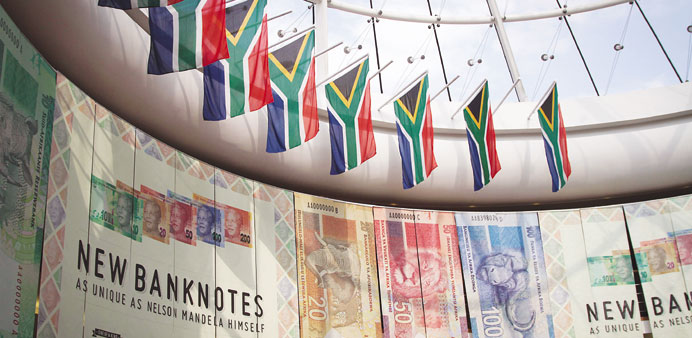
South African national flags hang above an advertisement for the new Mandela rand banknotes at the headquarters of the central bank in Pretoria. Twenty-three of 30 economists polled by Reuters this week expected the Reserve Bank to keep its repo rate at 5.5%.
Reuters/Johannesburg
South Africa’s Reserve Bank will probably keep interest rates steady at tomorrow’s policy meeting, although increases could be on the cards later in the year as inflation pressures remain a concern.
While the central bank has always stressed its independence from government in implementing policy, a rate hike now would alienate the powerful labour union allies of President Jacob Zuma’s African National Congress party as it seeks to extend its 20-year grip on power in May elections.
Earlier this month, the Reserve Bank moved to manage market expectations of steep rate hikes this year after a surprise increase in January, saying it will probably tighten policy more slowly than it did six years ago, to ease pressure on the ailing economy.
Central bank governor Gill Marcus reiterated that expectations in the short-term interest rate market for about 200 basis points worth of rate hikes this year were overdone given a negative output gap and subdued growth in household consumption.
The central bank’s mandate is to balance the need to keep inflation in check with that of promoting growth in Africa’s biggest economy, which has languished below 3% since a recession in 2009.
Twenty-three of 30 economists polled by Reuters this week expected the Reserve Bank to keep its repo rate at 5.5% on Thursday after lifting it by 50 basis points in January, with a recent recovery in the rand helping ease inflation pressures.
Only four stuck out for another 50 basis point increase on Thursday, while three thought the South African Reserve Bank (SARB) would break with the long-standing tradition of half a percentage point adjustments per meeting and opt for a softer 25 basis point addition.
“Having only just tightened in January, the SARB in effect took into account the deterioration in inflation we are now seeing,” said Standard Chartered analyst Razia Khan.
“The currency has stabilized. So they are relieved of the pressure to do a lot more, this soon.”
However, nearly two thirds of analysts polled felt a rate hike was inevitable in the second quarter of the year, as the rand remains vulnerable to South Africa’s steep fiscal and current account deficits, making it prone to sharp losses during bouts of global risk aversion.
The rand has recouped some of the sharp losses seen at the start of the year which pushed it to five-year lows against the dollar.