


|
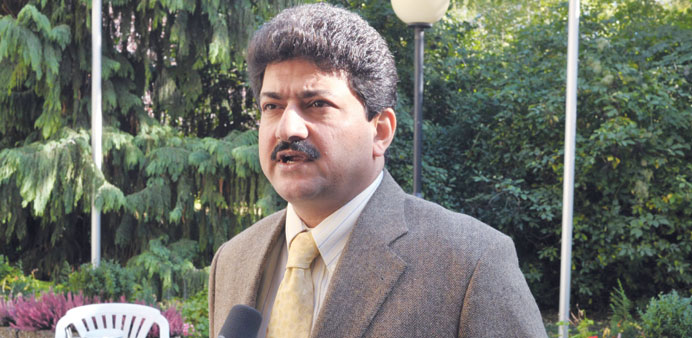
A storm is brewing in Pakistan following the assassination attempt on Hamid Mir, the face of the country’s vibrant but under-threat independent media, in the port city of Karachi last week. |
This storm has already sidetracked the immediate issue of how to protect journalists being targeted in the line of duty with impunity.
It has pitchforked the Inter-Services Intelligence (ISI), Pakistan’s premier intelligence agency - whose mettle is recognised by rivals on a global scale even if it gives them sleepless nights - against the Jang Group, the country’s leading media group for whom Mir anchors its flagship political TV show, Capital Talk.
Mir is a household name in Pakistan, recognised for his chutzpah: he has ruffled feathers by raising issues such as the missing persons case related to insurgency-hit Balochistan province that is controlled by the military, the Musharraf trial which is anathema to that institution, spoken out against the Taliban and consistently pitched his tent in favour of democratic forces.
The independent media in Pakistan has traversed quite a distance over the past decade, even allowing for the treacherous terrain. The space created by the electronic media in televising the revolution that led to the ouster of General Musharraf helped it cement its place as a major stakeholder in the redefined contours of the state.
The Musharraf gambit led, in due course, to unprecedented critique of the powerful security establishment, especially the role of its intelligence arms. Geo, the first private TV channel, led the show and has grown over the years to become a behemoth - liked and hated with equal intensity.
The government of Prime Minister Nawaz Sharif is perhaps the first one which has been spared its “wrath” but many perceive that to be the result of a tacit mutual understanding from before last year’s general elections that swept him into power as well as Sharif’s studied endeavour to curry favour with an entity that controls more than 50% of the Pakistani media and caused much grief to his predecessors.
Despite its vanguard role in creating public awareness and sustaining “pressure” thereof, Jang Group’s overall role through Geo TV and The News and Jang, its flagship English and Urdu dailies respectively, has come under the microscope. It is accused by its rivals of manipulating the public space for vested interest.
The Mir case has accentuated that charge because even though the journalist cited the ISI and its chief as the would-be responsible party in the event of an attack on him, Geo went to town about it, flashing footage of the ISI chief along with it. It is still not clear who took the editorial decision to make a song and dance of a mere accusation with no proof whatsoever, but it has come back to haunt the top dog viciously.
The Jang Group is now struggling to stay afloat after the ISI filed a complaint through the defence ministry with the Pakistan Electronic Media Regulatory Authority (Pemra), seeking to have Geo’s licence revoked. A show-cause notice has been served on the group for a hearing on May 6. This is an extreme step, but the media group has only itself to blame for jumping the gun.
The Jang Group is already facing isolation within the media industry, a situation for which it may find an own finger pointing at itself. Despite its secure position as the numero uno, its hubris has given birth to deep resentment and by not being forthcoming when others of its ilk have found themselves in a spot of bother, it has betrayed a selfish streak.
For instance, it continues to practice a policy of ambiguity in relation to any harm coming to other media outlets or practitioners of the trade. More often than not, it even eschews naming any other media outlet from which an employee may have been attacked or killed. Sometimes it does not even name victims if they aren’t from its own group. This practice is in stark contrast to what the other competitors practise.
Not surprisingly, some of the other media groups like the Express Media Group even chose to flay the Jang Group in a front page fizz following the Mir attack in which it accused the latter of “maligning national institutions”.
In a highly damaging move for the media’s own integrity, some outlets and Mir’s rival hosts are also having a field day at Jang Group’s expense and using the opportunity to drive a further wedge between the ISI and Jang Group and make a show of their own loyalty to the security establishment for vested interest.
The role of the Sharif government has assumed some significance given the impending clash. Despite visiting Mir at the hospital and setting up a judicial commission to probe the attack on the journalist, Prime Minister Nawaz Sharif’s government appears to be giving confusing signals.
While the Federal Information Minister Pervaiz Rashid suggested it was evident where his party’s sympathies lay with the PM’s visit, Federal Interior Minister Chaudhry Nisar Ali Khan chose to rap the Jang Group, saying the government would not allow anyone to run down national institutions.
The military has moved to stop the transmission of Geo in cantonment areas with reports purporting coercive measures to force the cable operators to take it off in the cities as well even before the Pemra hearing.
With Mir sticking to his stance that the spy agency was to blame for the attack on him and the Jang Group defiant, uncertainty reigns even as the government claims it is mediating behind-the-scenes to ask both the parties to back off.
Needless to say extreme measures would be unhelpful and therefore, both the parties would be well advised to exercise restraint and wait for the probe instead of getting into a battle of attrition.
♦ The writer is Features Editor.