


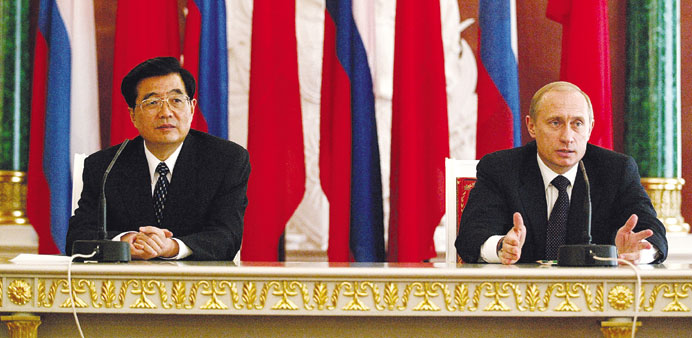
Chinese President Hu Jintao (left) listens as Russian President Vladimir Putin speaks after signing the $400bn gas deal on May 21 at a news conference in Moscow.
For once, China looks to have done Japan a favour. In clinching a $400bn deal last month to buy Russian gas, China may end up helping out its old political and economic rival in a way that matters hugely for Japan – energy security.
The China-Russia agreement, the biggest gas deal ever, unlocks new gas supplies and could bring down gas prices across Asia, a development that would pay the biggest dividends for Japan, the world’s top buyer of liquefied natural gas. Other big Asian gas buyers such as South Korea and Taiwan could also benefit.
The deal, signed on May 21, cemented a dramatic shift in energy flows from the West to the East. Gas will be transported to China via a new pipeline linking Siberian gas fields from 2018, building up gradually to 38bn cubic metres a year. China has massive gas needs, but access to more of the fuel is also vital for Japan since its utilities pay the world’s highest prices. Japan buys about a third of global LNG shipments and spent a record ¥7.06tn ($70bn) last year, mostly for electricity generation to replace idled nuclear reactors following the Fukushima disaster in 2011.
There are hopes that piping Russian gas to China will create a new price benchmark that could cut prices for Asian LNG buyers as well as providing new gas sources.
“This will surely put downward pressure on gas prices and some say it is the beginning of the end of the Asia premium,” Masumi Kimura, a researcher at Japan Oil, Gas and Metals National Corp (JOGMEC), said in a note, referring to the higher price paid for gas in Asia compared to other parts of the world.
Russia’s Gazprom declined to confirm what price the deal with China was struck, but industry sources say it translates to about $10-$10.50 per million British thermal units, an international pricing standard, well below the current level of around $13 for spot Asian cargoes.
A source at one of the biggest Japanese buyers of gas shipped in liquid form said that the new Russian gas should absorb some Chinese pressure on LNG demand in Asia. Others were cautious, however, over the potential impact. “The Russian gas will be coming into the northeast of China, into a market that was never going to be served by LNG in the first place,” said Gavin Thompson, head of Asia-Pacific gas and power at consultancy Wood Mackenzie.
Takashi Hayasaki, general manager of the Japan Petroleum Development Association, said the China-Russia pipeline would “also spur further development of gas fields in Siberia that could be a source of LNG for Japan.”
Japan’s Russian purchases have grown with oil and gas flowing from Sakhalin island to the north of Japan since 2009 and oil via the East Siberian Pacific Ocean extension from 2012.
Imports of Russian LNG rose 3.1% last year to 8.57mn tonnes, or 9.8% of total imports. The ratio is up from 4.3% in 2009 when Japan started Russian gas imports.
Prime Minister Shinzo Abe met Russian President Vladimir Putin five times in the last 18 months, more than any other leader. Amid a flurry of agreements there was talk that closer energy ties could come with the resolution of an island dispute dating from the end of World War II. But the diplomatic efforts to take a bigger role in gas projects appear to have fizzled out since the Ukraine crisis, which has led to sanctions on Moscow that Tokyo has supported.
Gazprom and Royal Dutch Shell operate Russia’s only LNG plant on Sakhalin, with Japan’s Mitsuibishi Corp and Mitsui & Co as junior partners. The Chinese deal has also revived talk of a pipeline from Russia to Japan. A group of 33 ruling party lawmakers plans to lobby Abe to sign a deal on a gas link with Putin at an estimated cost of about $6bn compared with more than $40bn for the Chinese pipeline.
But Daiske Harada, an economist with JOGMEC focusing on Russia, said Rosneft and Gazprom were more interested in pushing exports by LNG to the Pacific market, not by pipeline. Gazprom plans to build a second plant in Vladivostok by 2018, with a capacity of 10 and 15mn tonnes of LNG per year, and also a spur to the Chinese pipeline to bring gas to Vladivostok.