


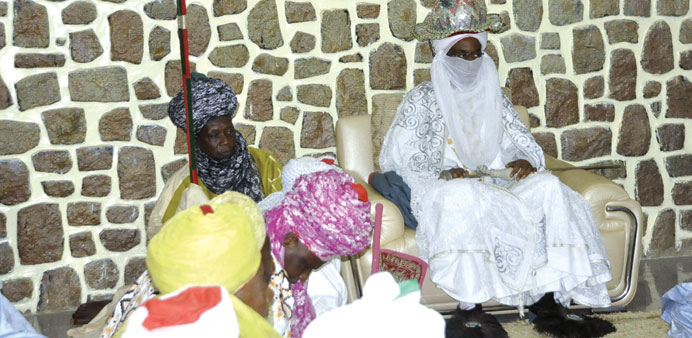
Lamido Sanusi, right, the new emir of Kano, takes his seat in Kano city. Hundreds of youths protested on Monday against a decision to appoint Nigeria’s former central bank governor as the country’s second-highest Islamic authority. The decision surprised many who had expected the job to pass from father to son as a sign of stability when the north faces an Islamist insurgency.
Agencies/Lagos
Five people were killed in Boko Haram raids on two villages near a town in northeast Nigeria where more than 200 schoolgirls were kidnapped nearly two months ago, residents said yesterday.
Gunmen dressed in military uniform stormed Tohya and Wurojene, 13km from Chibok, Borno state, late on Monday, opening fire on residents, burning homes and looting food stores.
“The attackers are obviously Boko Haram and came around 7pm (1800 GMT),” Zamani Emma, a community leader in Tohya, told AFP.
“They opened fire on the two villages and threw petrol bombs into our homes, forcing us to flee into the bush.
“When we returned the next morning we recovered five corpses and found scores of our homes burnt while all our food supplies were taken away.”
Wurojene resident Mansur Ahmed gave a similar account and said the attackers came from the Sambisa forest, where Boko Haram has camps and which has been the focus of the hunt for the missing girls.
At least 20 nomadic women were at the weekend kidnapped by suspected Boko Haram gunmen in nearby Garkin Fulani village and taken to an unknown location.
On Monday the Islamists took over Biita and Izghe villages—also in Borno state—in an apparent revenge attack against the military after scores of its fighters were killed.
Nigeria’s military announced on Monday that its troops killed some 50 insurgents in Biita and recovered arms and ammunition at the weekend.
“Boko Haram have take over Biita and Izghe after overwhelming soldiers,” said Peter Makama, a resident of nearby Madagali, in neighbouring Adamawa state.
“The soldiers fled after Boko Haram launched a counter-offensive following a crushing defeat at the hands of the soldiers in fighting on Saturday and Sunday.”
A military source in the Borno state capital, Maiduguri, confirmed the incident but claimed the soldiers had made a tactical withdrawal when faced with hundreds of militant fighters.
“Around 400 Boko Haram terrorists launched a counter-offensive on our troops on Monday after the heavy casualties they sustained in the military offensive at the weekend,” the source said.
“Our troops made a tactical withdrawal from Biita and Izghe given the huge numbers of terrorists and the limited ammunitions at their disposal.
“We will re-strategise to re-take the two villages now occupied by the terrorists.”
The UN Security Council is set to sanction Abubakar Shekau, leader of Nigeria’s Boko Haram, and its faction Ansaru, the first individual and entity to be designated by the world body since the Islamist militant group was blacklisted last month.
Russia has delayed the process by placing a technical hold on the designations, but diplomats say it is simply to give Moscow more time to complete its review of the proposal made by Nigeria to the Security Council Al Qaeda sanctions committee.
“We would expect those listings to be approved and they would be sanctioned perhaps by the end of the week or early next week,” said a senior council diplomat, speaking on condition of anonymity.
Once Russia lifts the hold, Shekau and Ansaru would be banned from international travel and have their assets frozen.
Last month, the Security Council Al Qaeda sanctions committee blacklisted Boko Haram at the request of Nigeria.
The Islamist group was described in the UN listing as an affiliate of Al Qaeda and the Organisation of Al Qaeda in the Islamic Maghreb (AQIM). It is subjected to a travel ban, an asset freeze and an arms embargo.
Boko Haram faction Ansaru, which is blamed for the killing of several Western hostages, is AQIM’s bona fide affiliate in Nigeria, and called itself “Al Qaeda in the Land Beyond the Sahara” in a video with a British and Italian hostage in 2011.
Ansaru broke off from Boko Haram in protest at its killing 186 mostly Muslim civilians in the medieval Islamic city of Kano in early 2012. Shekau is the purported leader of Boko Haram. A year ago, US Secretary of State John Kerry authorised a reward of up to $7mn for information leading to his location.
Boko Haram’s five-year-old insurgency is aimed at reviving a medieval Islamic caliphate in modern Nigeria, whose 170mn people are split about evenly between Christians and Muslims. The group is becoming, by far, the biggest security threat to Africa’s top oil producer.
Boko Haram, which in the Hausa language broadly means “Western education is sinful,” is loosely modeled on the Taliban movement in Afghanistan.