


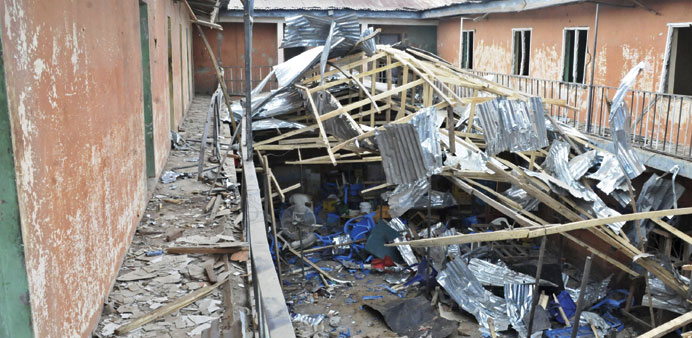
Rubble is seen at a hotel destroyed by an explosion in the northern Nigerian city of Bauchi. Reports say at least 10 people were killed and 14 others were injured overnight in an explosion. The latest attack comes just two days after a bomb explosion in the capital city Abuja that killed more than 20. While no one claimed responsibility for the attack, such attacks are often blamed on Nigeria’s Islamist militant group Boko Haram.
DPA/Reuters/Lagos
An explosion at a red light district in the northeast Nigerian city of Bauchi killed 10 people and wounded 14, police said yesterday.
No one has claimed responsibility for the attack, but the radical Islamist group Boko Haram has targeted Bauchi in the past.
The blast took place late on Friday at a building on the outskirts of the city believed to have been used as a brothel.
“The entire area has been cordoned off and (the) scene secured,” state police spokesman Mohammed Haruna said.
Boko Haram, which launched its insurgency against the government in 2009 with the aim of creating an Islamic state in Nigeria, has killed more than 2,000 people in the country’s north this year alone.
Police arrested one suspect yesterday in connection with the blast in the People’s Hotel brothel, Bauchi state police spokesman Haruna Mohammed said. He gave no further details.
A military operation in the northeast has so far failed to quell the rebellion and has triggered a string of reprisal attacks on officials and civilians.
Boko Haram’s targets often include places it considers sinful according to its austere brand of Sunni Islam, such as bars, schools or churches.
The insurgents say they are fighting to carve an Islamic state out of religiously-mixed Nigeria, Africa’s most populous country, biggest economy and leading energy producer.
Bauchi state, like neighbouring Jos, lies on Nigeria’s volatile “Middle Belt”, where its largely Christian south and Muslim north meet.
The region has been less frequently attacked by Boko Haram than its heartland in the remote northeast.
But the militants seem keen to extend their reach beyond Borno state, where military operations against them have been focused.
A bomb in an upmarket shopping district of the capital Abuja killed 21 people on Wednesday, the third attack on the capital in three months.
In Nigeria’s second-biggest city of Kano, the relic of a mediaeval Islamic caliphate, police acting on a tip-off said that they had found and defused a bomb consisting of 13 cylinders of explosives next to the Jumat Praying Ground late on Friday.
“The high-grade explosives were loaded into a rickety red (Toyota) Starlet,” Kano police commissioner Alhaji Adenrele Shinaba told journalists at a news conference. “They were primed to explode on worshippers.”
Boko Haram often attacks mosques as well as churches, especially if they are seen as too moderate.
The insurgents have killed many thousands since launching an uprising in 2009, and see all those who do not share their views as enemies.
President Goodluck Jonathan visited the scene of the Abuja blast on Friday and said that Nigeria had entered one of the darkest phases of its history.
The kidnapping of more than 200 schoolgirls from the village of Chibok in April made world headlines and elicited offers of help from Western powers to get them freed, although global public interest is now waning.
The United States reduced its surveillance flights to help find the girls after building a body of intelligence, and after other states ramped up support, a US official said on Friday (see accompanying report).
Jonathan’s administration has been bruised by criticism of its failure to contain the insurgency or protect civilians, especially in the volatile northeast.
“I have had to remain quiet about the continuing efforts to find the girls kidnapped in April,” Jonathan wrote in the Washington Post on Thursday, saying he was concerned his critics would equate his silence with “inaction or even weakness”.
“We have not stopped and will not stop until the girls are returned home,” the Nigerian president wrote.