


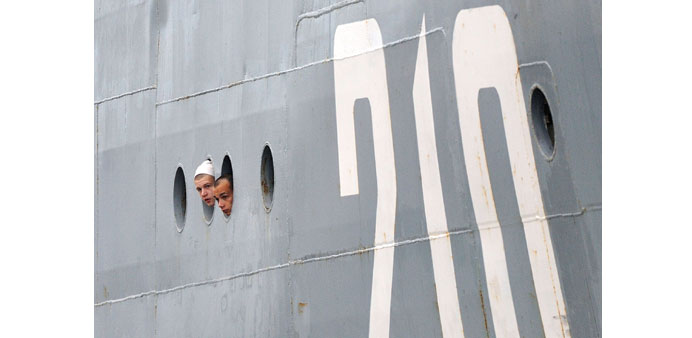
Russian sailors look through the porthole as they arrive aboard the Smolniy yesterday in Saint-Nazaire, western France. Four hundred Russian sailors will be trained on the Vladivostok warship, a Mistral class LHD amphibious vessel ordered by Russia to the STX France shipyard. The Vladivostok warship is one of the two navy ships ordered to France by the Russian army.
Reuters
About 400 Russian sailors arrived in western France yesterday for training on Mistral amphibious assault ships before the first of two is delivered to Moscow by the end of the year.
The United States and some European partners have urged Paris to reconsider the €1.2bn ($1.6bn) sale to Moscow following Russian action in Ukraine, including its annexation of the Crimean Peninsula in March.
France has rebuffed those calls, saying that cancelling the deal would do more damage to Paris than Moscow, illustrating the limitations of European Union sanctions meant to punish Russia.
Television pictures showed a Russian frigate carrying the sailors arriving at the Saint-Nazaire shipyard yesterday morning.
The men are due to familiarise themselves with the first carrier, named Vladivostock, over the next few months.
About 50 people demonstrated outside the shipyard on Sunday demanding Paris cancel on the sale.
The European Union has threatened Moscow with more penalties beyond existing asset freezes and visa bans unless pro-Russian rebels act to ease the crisis in eastern Ukraine.
Paris has said other countries must share the burden in imposing sanctions on Russia and that any measures should also include the energy and financial sectors as well as defence.
The Mistral ships were Moscow’s first major foreign arms purchase in the two decades since the fall of the Soviet Union.
The carriers can hold up to 16 helicopters, such as Russia’s Ka-50/52s, four landing barges, up to 70 vehicles – including 40 tanks – and 450 soldiers.
Former president Nicolas Sarkozy had hailed the signing of the Mistral contract as evidence the Cold War was over, although the 2011 deal had alarmed some of France’s Nato allies in the aftermath of the country’s 2008 war with Georgia.
The contract has created about 1,000 jobs in France.
The first carrier is due to be delivered by the last quarter of 2014. The second one, named Sebastopol after Crimea’s crucial seaport and illustrating its importance to Moscow, is supposed to be delivered by 2016.