


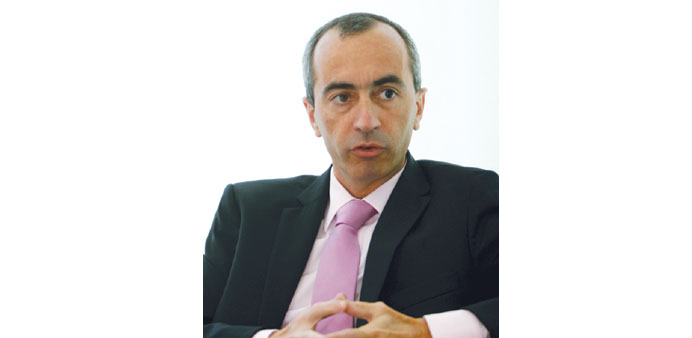
Chalmin talking to Gulf Times in Doha yesterday. PICTURE: Nasar T K
By Pratap John/Chief Business Reporter
Total E&P Qatar sees “interesting potential” in the offshore Al Khalij field, for which it has signed an agreement with Qatar Petroleum to form a joint venture for 25 years from 2014.
Under the new joint venture, QP and Total hold respectively 60% and 40% interest in the field. Total continues to operate the field.
The JV intends to enhance oil recovery as much as possible from this mature offshore field, said Total E&P Qatar managing director and Group representative Guillaume Chalmin.
With this in mind, last month, Total E&P Qatar had commenced a large-scale 4D seismic acquisition survey in Al Khalij field Block 6, which is located 130km off the coast of Doha. The use of this technology is quite innovative for carbonate oil reservoirs. This follows a ‘successful’ 4D seismic pilot that was carried out in the oilfield by Total E&P Qatar in 2012.
“The 4D seismic pilot has given us pretty encouraging results,” Guillaume Chalmin said in an interview with Gulf Times here.
The main objective of this survey is to utilise seismic technologies to analyse the evolution of the Al Khalij oilfield over time. A 4D seismic survey is performed to determine the changes occurring in the reservoir as a result of hydrocarbon production or injection of fluids into the reservoir by comparing the repeated data sets, Guillaume Chalmin stressed.
For Al Khalij, this new seismic survey will be compared to the initial 1999 baseline survey. The comparison will help through processing and interpretation to better understand the production mechanisms that have been taking place over the past 15 years.
The survey, which will be carried on until end-August, will be performed by five marine vessels within the Al Khalij field, which is operated by Total in partnership with Qatar Petroleum.
Asked whether enhancing the output at Al Khalij, which currently stands at an average 23,000 barrels a day, or maintaining the plateau was the priority, Guillaume Chalmin said, “We will see with QP what is optimum for the Al Khalij field. But there is clearly a willingness to make the most of it in terms of oil recovery, without any compromise on safety and with a strict investment discipline.”
Although Al Khalij is not a “brand new field”, Chalmin sees “interesting potential” from this geologically complex field. Since 1997, Al Khalij has been in production. Since then the cumulative production of crude oil (from Al Khalij) stood at 0.2bn barrels (end-2013 figure).
At present, the field operated with some 58 wells (48 of which are oil producers) and eight platforms.
Since arriving in Qatar close to 80 years ago, Total has had a continued presence in the country. Total is among the few international major energy companies, if not the only one, that has been involved across the oil and gas value chain in Qatar from exploration to marketing. Besides Al Khalij oil field, Total holds shares in both Dolphin Energy and Qatargas, the world’s largest liquefied natural gas producer.
Total is also a partner in the ‘BC’ exploration block, offshore Qatar.
Total has a 10% stake in the Ras Laffan Refinery, a condensate splitter with a capacity of 146,000 barrels per day (bpd).
Chalmin explained that the expansion project (to double the Ras Laffan Refinery capacity) was firmly on track and expected to be onstream by 2016.
Total also has a 20% stake in Qapco and a 36.6% direct stake in Qatofin petrochemical plants. The company is also involved in Ras Laffan Olefins Company (RLOC) through a Qatofin stake of 45.7%.
On the prospects of developing renewable sources of energy such as solar in Qatar, Chalmin said, “We are more than willing to work with our Qatari partners in solar energy, where Total is a major player worldwide. Although, Qatar is not a country where the added value of solar energy is as obvious as in some other countries due to its bountiful gas resources, there is still room for solar energy here.” Paris-based Total has a majority stake in the San Jose, US-based SunPower, one of the biggest global player in solar power worldwide.
Total, Chalmin said, was proud of the fact that it was contributing to Qatar’s R&D through the Total Research Centre in Qatar (TRC-Q) at the Qatar Science & technology Park. This is the only research centre from Total outside of France working both on the upstream and downstream business segments.
At TRC-Q, the team of researchers is working on topics such as carbonate reservoirs (acid stimulation, geochemistry), metrology (production metering) or CO2 conversions into valuable by-products.
Sustainable development is core commitment of Total in Qatar
In addition to investments in Qatar’s energy sector, sustainable development is a core commitment of Total in Qatar.
The Paris-based global energy major, which has been in Qatar for close to 80 years without interruption, supports long-term projects in the country to promote education, research, environmental protection and local economic development.
Total backs Qatar’s drive to become a centre of excellence for research through its integrated research centre, which opened in 2009 at the Qatar Science and Technology Park (QSTP).
Total’s human development strategy is highlighted in its support for education through its partnership with Qatar Foundation and Qatar University, as well as top international universities such as HEC Paris and IFP School. This partnership has helped bring forward high quality education to Qatar.
Total also deployed its technical experts to interact with students in the Qatari universities. In addition, Total has also established various international scholarship, sponsorship and internship programmes for its stakeholders.
Presenting its diverse, dynamic and committed workforce, Total outlined its commitment to attract, develop and retain talented individuals in the company.