


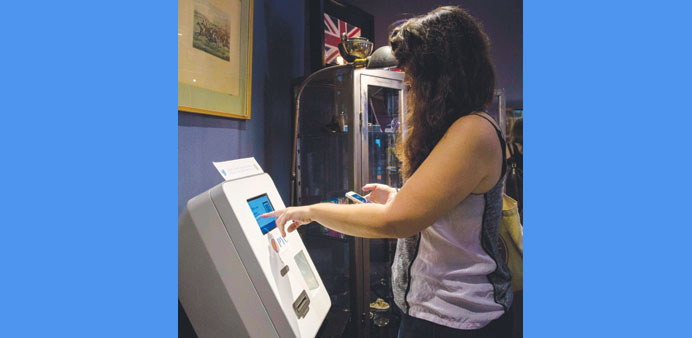
A customer makes a transaction at a bitcoin ATM located at a boutique in New York’s West Village last month. Australia-based bitcoin startup Igot announced on August 29 it had launched a bitcoin exchange in the UAE, operating with a commercial brokerage licence and being fully regulated by local authorities.
By Arno Maierbrugger/Gulf Times Correspondent/Bangkok
The GCC has got its first exchange for the controversial Internet currency bitcoin. Australia-based Bitcoin startup Igot announced on August 29 it had launched a bitcoin exchange in the UAE, operating with a commercial brokerage licence and being fully regulated by local authorities.
Igot founder Rick Day said at the launch that the exchange is targeting – apart from the UAE’s wealthy native and expat population and institutional investors – also the large remittance market made up by migrant workers, especially the 1mn Indians working in the UAE.
Igot already has a strong presence in India and an office in Bangalore. “In terms of trade volumes, I think we’re the biggest local exchange in India,” Day said, indicating that the Indian diaspora in the UAE would likely make use of the new exchange there for remittances quickly.
The idea to send remittances through bitcoin exchanges is relatively new, especially in the Gulf Co-operation Council, but with the growing popularity of the cryptocurrency and its low transaction costs – Igot charges a 1% exchange fee and nothing for the remittance itself – migrant workers could increasingly acquire a taste to settle their remittances back home in bitcoins. The exchange rate risk of the volatile cryptocurrency – one of the main points of criticism – can be kept very low when the transaction (i.e. changing dirhams into bitcoins and back into the currency of the target destination) is done instantly.
Another market for bitcoin remittances are Overseas Filipino Workers (OFWs), the second largest group of migrant workers in the UAE with around 930,000 people. At a conference in Cebu, Philippines, two weeks ago, Ron Hose, co-founder and CEO of Manila-based Bitcoin exchange platform Coins.ph, stated that sending remittances in bitcoins could be a good alternative to using traditional banking channels or money transfer services to avoid intermediaries and high costs. It could also make it easier for people who do not have bank accounts at all.
Coins.ph, as an example, accepts bitcoin transactions from anyone, also from people who do not have credit cards or bank accounts, whose number in the Philippines is estimated at 95mn out of a population of 100mn. Coins.ph also runs a low-cost remittance platform specially targeted at OFWs.
Up to now, the problem for residents in the UAE was that to exchange “real” money into bitcoins. The Middle East and with it the GCC are some of the least integrated regions within the global bitcoin network, although activities from entrepreneurs and startups, for example Dubai-based Umbrellab, are under way to change that. The first bitcoin ATM has been activated in Dubai in April this year where people can deposit cash into their bitcoin wallet, or virtual account, which they need to send
money.
The exchange value is, however, limited to 10,000 dirhams per month.
Bitcoin advocates in the Middle East say that the region is predestined for a bitcoin ecosystem with its large number of “unbanked” people, a youthful population and millions of migrant workers. The global market is actually huge: India has topped the ranking of remittances with a whopping $71bn sent in 2013, Filipinos sent a record $25.1bn back home. In total, developing countries received $410bn in remittances, according to the World Bank, and the volume should rise to $540bn by 2016.