

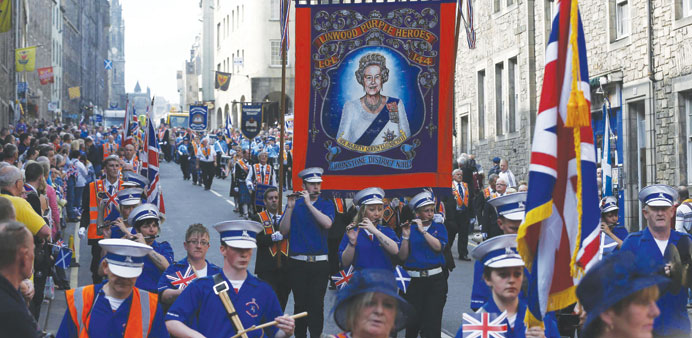
Members of the Orange Order march in Edinburgh with a portrait of Queen Elizabeth.
By Angus MacSwan, Reuters/Edinburgh
About 12,000 Protestant unionists, including contingents from Northern Ireland, marched yesterday through Edinburgh’s Old Town in an emotional show of support for keeping Scotland in the United Kingdom.
With fife and drum bands, bowler hats and orange sashes, the marchers said the referendum on Scottish independence, which takes place this Thursday, threatened their culture and history.
“It’s your own history being taken away from you. What will you tell your grandchildren?” said Jim Prentice, a gardener, wearing a Rangers soccer club shirt, who had travelled from south of Glasgow to watch the march.
Organised by the Orange Order of Scotland, the march demonstrated that the anti-independence campaign could count on a solid, substantial, bloc of votes in Glasgow, Scotland largest city and the main battleground of the campaign.
But it also injected a sectarian element with a bitter and sometimes violent history into the campaign. The Order is linked to the Northern Ireland Protestant “loyalist” organizations and many lodges had crossed over the Irish Sea for the event.
Rivalry between Catholics and Protestants - famously manifested by supporters of Glasgow’s Celtic and Rangers soccer clubs - has often been a blight on Scottish society.
The decision to march has been controversial.
The official pro-union Better Together campaign had said the parade had nothing to do with them. However, spectators displayed signs, badges and stickers bearing the campaign’s slogan – ‘No Thanks’.
Some marchers chanted “No Surrender” - a slogan from the conflict in Northern Ireland.
A Scottish vote for independence could force England and Northern Ireland to reassess their own constitutional relationship, an issue which haunts the delicate peace between Catholics and Protestants in the British-controlled province.
But the atmosphere yesterday was generally festive as marchers filed through Edinburgh’s Old Town which dates back to the Middle Ages. Many people on the march or lined up along the streets carried Union Jacks as well the Scottish saltire flag.
“Proud to be British, Proud to be Scottish,” banners read.
Support for independence and support for the union are running neck-and-neck in the polls.
Independence supporters say it is time for Scotland to rule itself, free of politicians in London.
“No” campaigners say that Scotland is more secure and prosperous as part of the United Kingdom, and the end of the union would destroy three centuries on bonds and shared history, as well as be an economic disaster.
“I was brought up in Barnet (London). My father was a soldier,” said Prentice. “I’ve got cousins who are English, Irish, Scousers (from Liverpool). We’re all part of the UK.”
Lodge member David Hughes, wearing a smart suit and Orange Order regalia, said he had come up from Liverpool in Northern England to show solidarity and was confident the “No” vote would win on Thursday.
“We’ve been together 300 years. It works, why break it?” said Hughes, a member of the 64 Garton “True Blue” Lodge.
He mocked pro-independence leader Alex Salmond’s promises of greater prosperity for all.
“What happens when the oil runs out? What happens to the jobs at Faslane?” he said, referring to the naval base on the Clyde which hosts Britain’s nuclear submarines. “The bottom line is we are better together.”
Jacqueline McWhinnie, a transport supervisor, had come from Glasgow with her family for the march.
“We are not interested in independence. We are better off in the union, more secure. Alex Salmond is not giving us any answers,” she said. “I’m very proud to be Scottish but we are also part of Great Britain. If we say ‘Yes, we can’t go back.”
Independence supporters kept a low profile during the march, although it passed some establishments with “Yes” banners hanging from the windows.
The Orange Order takes it name from Dutch-born William of Orange, who defeated Catholic forces of King James II at the Battle of the Boyne in 1690. Some banners depicted William on his horse.
Dedicated to defending the union and Protestant interests, it holds huge annual marches in Northern Ireland and Scotland that in the past have erupted in violence.
At least one Catholic was out in support of the union yesterday.
Company commercial director Craig Begg, standing next to McWhinnie as the marchers filed down ‘The Mound’ from the Old Town, said a split from the union made no business sense at all. “I’m a ‘No’ voter and a Catholic, he said, adding “It’s good to see people flying the Union Jack without being accused of being racist.”
Rising Scottish support for staying in union
Scottish support for independence has declined, a poll for Survation showed yesterday, widening the lead for the pro-union campaign just 5 days before Scotland votes on whether to separate from the rest of the United Kingdom.
A Survation poll on behalf of the pro-union Better Together campaign found support for staying in the United Kingdom was at 54%, while 46% were planning to vote for independence on September 18, once the undecided were excluded.
The poll comes as a boost to the anti-independence campaign after the latest “poll of polls” on Friday showed the vote remained on a knife-edge, with just 51% support for staying in the UK.
Survation’s last poll on Wednesday showed unionists on 53% and separatists on 47%. The poll released yesterday showed 9% of Scots were still undecided.
While polls had consistently shown strong leads for the “No” campaign to reject independence, a recent surge in support for “Yes” has prompted some investors to sell the pound and the shares of Scottish companies over concerns about the economic ramifications of a split.
The Survation poll found that 40% of respondents believed they and their families would be worse off financially in an independent Scotland, with just 27% saying they thought they would be better off.