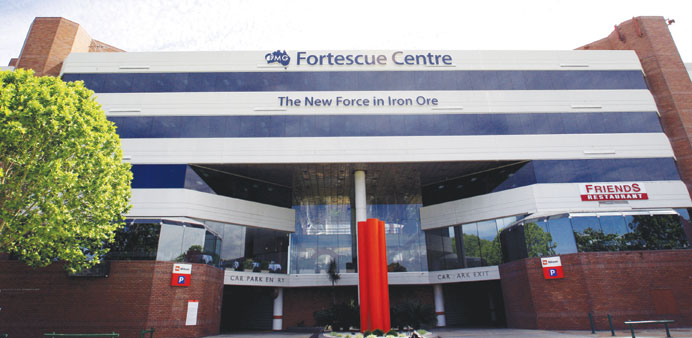

The Fortescue Metals Group headquarters in Perth, Australia. The bond market is sceptical about Fortescue founder Andrew Forrest’s confidence in how well the miner can withstand the collapse in iron ore prices.
Bloomberg/Sydney
The bond market is sceptical about Fortescue Metals Group founder Andrew Forrest’s confidence in how well the miner can withstand the collapse in iron ore prices.
Fortescue’s bonds delivered a 6.2% loss since February 28, their worst monthly result since November, Bank of America Merrill Lynch indexes show. China’s sagging economy drove iron ore down 18% last month, helping derail a planned $2.5bn bond sale the world’s fourth-biggest iron-ore miner had planned to use for refinancing.
“I don’t think it’s a great deal of debt, I think it’s totally manageable,” Forrest said in an interview March 28 at the annual Boao Forum on the southern Chinese island of Hainan, referring to Fortescue’s $7.5bn in net obligations. For the March refinancing there was “an enormous amount of interest, but we had a pretty erratic market. We could have filled our book easily, but the cost of that money wasn’t what Fortescue had determined was a fair price.”
Rivals including Rio Tinto Group rejected a proposal from Forrest to cap iron-ore output, sending the steelmaking material toward its steepest quarterly drop since at least 2009. Forrest’s net worth shrank $780mn this year to $1.6bn, data compiled by Bloomberg show. The company’s 2022 notes trade at 74 cents to the dollar, down from above par in November.
“Fortescue is certainly a risky play within the current iron-ore pricing environment, and a credit I would have to think long and hard before taking any exposure,” Scott Rundell, chief credit strategist at Commonwealth Bank of Australia in Sydney, said by phone. “It’s difficult to identify what mechanism could drive iron ore prices materially higher this year and perhaps next year as well, so their situation’s unlikely to improve anytime soon.”
Perth-based Fortescue on March 18 announced it had scrapped plans to refinance some of its US debt with a $2.5bn bond and extend a $4.9bn loan’s maturity.
The seven-year senior secured dollar-denominated notes were being marketed to yield 8% to 8.25%, according to a person with knowledge of the deal who asked not to be identified, citing lack of authorization to speak publicly. Some lenders had been looking for an all-in yield of 9%, according to two people familiar with the matter.
The company’s existing 2022 unsecured US currency notes, sold in 2012, yielded about 12.6% on Tuesday in New York, 10.87 percentage points more than Treasuries, according to Trace pricing. The spread has widened from 8.35 percentage points at the end of February and reached the highest on record for the securities.
“If we were really worried about it, we would’ve just grabbed it and run,” Forrest said. “We have debt maturing in 2017, 2018, 2019, 2022. We can refinance that at any time. We can push all that debt out, if we wish to, to the next decade.”Ore with 62% content at the Chinese port of Qingdao retreated to $49.53 a dry metric ton on Tuesday. That’s the lowest in a decade, based on data from Metal Bulletin and annual benchmarks compiled by Clarkson Plc, the world’s largest shipbroker. Forrest last week attracted criticism from peers with a call for suppliers to cap output to stabilise prices.
Shares in Fortescue, which has a market value of A$5.9bn ($4.5bn), tumbled 21% in March and closed at A$1.895 on Wednesday in Sydney.
The largest iron-ore producers including BHP Billiton and Rio Tinto have been boosting supply to lower average costs. Fortescue is targeting further savings after net income fell 81% in the six months ended December 31 to $331mn.
“They’ve got a rough period ahead of them, especially with continued weakness in Chinese steel demand,” CBA’s Rundell said. “There is a case to be made for further downside to the iron ore price and risks to cash flow are mounting.”
Fortescue needs iron ore to trade at $57 a ton to be cash breakeven, UBS Group analyst Glyn Lawcock wrote in a March 18 note to clients. Including interest payments and capital expenditure, the producer’s breakeven price to deliver ore to China is $41 a ton, Chief Executive Officer Nev Power said on the same date.
Forrest, who founded the company and saw it through a refinancing in 2012, remains upbeat, saying on March 28 that Fortescue is still operating at a significant margin.
“That balance sheet is rock solid,” he said. “We can take debt from several sources if we wish to. We’ve been offered more equity than I care to imagine. Right now, I’m not concerned.”