


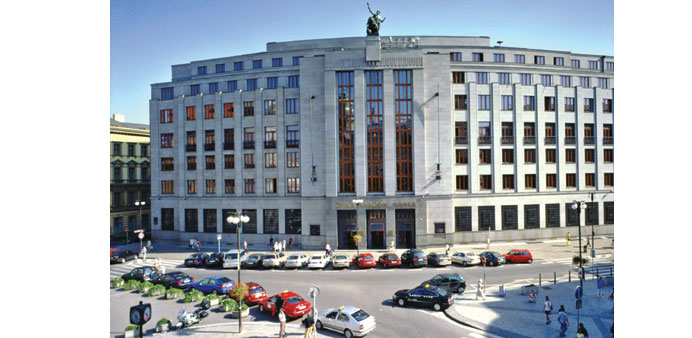
A view of the Czech National Bank in Prague. In a letter to the bank’s governor Miroslav Singer, Deputy Finance Minister Martin Pros has referred to “unsettling reports concerning Pribor rates, of which the most serious ones include concerns of their manipulation”.
Deputy minister sends letter to central bank after reports; says “suspicions of manipulation with Pribor exist”; says rates too high, money market “almost frozen”
Reuters
Prague
The Czech Finance Ministry has asked the central bank to investigate whether the Prague Interbank Offered Rate (Pribor), the main benchmark for the country’s money market, may have been manipulated to keep interest rates high.
In a letter to bank Governor Miroslav Singer, Deputy Finance Minister Martin Pros referred to “unsettling reports concerning Pribor rates, of which the most serious ones include concerns of their manipulation”.
The letter, shown to Reuters by Pros, added: “We believe that suspicions of manipulation with Pribor exist and have a real basis and that the CNB (central bank) should therefore properly and thoroughly investigate.”
Pros did not accuse any individual or institution of wrongdoing in the letter, which CNB communications head Marek Petrus said the bank had received, declining to comment further.
Money market benchmarks worldwide have been under increased scrutiny since a rate-rigging scandal that undermined confidence in the London interbank offered rate (Libor). Its full extent became clear in 2012 when Barclays reached a settlement with regulators, the first bank to do so.
Pros’ letter referred to a March article in business daily Hospodarske Noviny that argued Pribor rates were kept artificially high
Pros, a former corporate and investment banking lawyer, told Reuters that almost no money market funds were offered for Pribor rates, showing they were not at the right level.
“The Czech money market has been almost frozen for several years,’ he said. “If Pribor were market equilibrium rates, there would be faster circulation of money in the money market.
“Nobody knows (where the rates should be) as they should be determined by the market but definitely they should be lower than today.”
Pribor is administered by the Financial Markets Association of the Czech Republic and fixed daily from contributions by six banks. Thomson Reuters is contracted to provide the daily calculation, a Thomson Reuters spokesman said.
The contributing banks are Ceska Sporitelna, a local subsidiary of Austria’s Erste Group ; Belgian bank KBC’s CSOB; French Societe Generale’s Komercni Banka ; and the local units of Russia’s Expobank, Austria’s Raiffeisen and Italy’s UniCredit .
A spokesman for CSOB said its contribution process was “compliant with all currently applicable European regulatory standards.”
Spokespeople at the other banks had no immediate comment. The president of the Financial Markets Association could not be reached.
Pros said the central bank should have oversight authority over Pribor given the rate is being used as the reference rate for many bonds, including state debt, and for floating mortgage rates, Pros said in the letter.
“Possible manipulation with Pribor would have a negative impact on consumers and would mean a massive unjustified enrichment of banks,” he said.
In all, US and European authorities have fined banks more than $6bn for alleged manipulation of Libor and its euro cousin Euribor, and more than a dozen people have also been charged with fraud-related offences.
The two-week Pribor rate, corresponding to the central bank’s main repo rate, was fixed at 0.16% on Friday. Until last month it had been at 0.17% since November 2013 when it dropped after the central bank launched interventions to weaken the crown currency to loosen monetary conditions.
The two-week repo rate has been at 0.05% since 2012.