


Reuters/AFP
Nicosia
Leaders of ethnically split Cyprus agreed late on Monday to restart peace talks on Friday, May 15, a UN envoy said, offering fresh hope of healing one of Europe’s most enduring frozen conflicts.
Espen Barth Eide was speaking to media after a meeting between Greek Cypriot leader Nicos Anastasiades and Turkish Cypriot leader Mustafa Akinci.
It was their first encounter since Akinci, a moderate leftist, swept to victory in a Turkish Cypriot leadership election on April 26.
“They agreed it was important to use the momentum created and opportunity to move forward without delay,” Eide told journalists outside a landmark hotel straddling a ‘buffer zone’ that has split the capital Nicosia for decades.
Once catering to Hollywood royalty, the Ledra Palace Hotel is now a shabby shadow of its former self, and is used as living quarters for British peacekeepers.
The division of Cyprus has defied attempts by generations of diplomats to find a settlement.
The east Mediterranean island has been divided since the Turkish army invaded in 1974 in response to a brief Greek-inspired coup aimed at union with Greece.
The seeds of division had been sown at least a decade earlier, when power-sharing crumbled into violence just three years after independence from Britain.
Eide said the two leaders had agreed to meet on May 15 to have a “general exchange of views” and discuss the modalities and structure of negotiations.
“This is a unique opportunity, an opportunity to be grasped,” said Eide, a former Norwegian foreign minister.
Both sides officially agree in principle that the island should be united under a two-state federal umbrella, but past negotiations have foundered on issues such as the powers of a central government and the residency and property rights of thousands of internally displaced people.
The last major peace push collapsed in 2004, when Greek Cypriots rejected a reunification blueprint accepted by the Turkish Cypriots.
Northern Cyprus is financially and militarily supported by Turkey, the only country which recognises it as a separate state.
The Greek Cypriot government, which in practice controls only the south, represents the whole island in the European Union.
Yesterday the White House welcomed the news.
“The United States welcomes the announcement that Greek Cypriot and Turkish Cypriot leaders will resume settlement talks on May 15,” said National Security Council spokesperson Bernadette Meehan. “We reiterate our willingness to assist the process in any way the parties find useful.”
“We encourage the parties to reach a settlement as soon as possible to reunify the island as a bi-zonal, bi-communal federation, which would benefit all Cypriots as well as the wider region,” she said.
Yesterday Greek Foreign Minister Nikos Kotzias also said the resumption of UN-brokered peace talks present a “window of opportunity” to reunify the divided island of Cyprus.
“We are facing a window of opportunity for Cyprus, as American diplomats say,” Kotzias told a joint news conference with his Turkish counterpart, Mevlut Cavusoglu, in Ankara.
In his first visit to the Turkish capital as foreign minister, Kotzias – speaking in Greek – said that “a settlement to the Cyprus problem will help solve a lot of problems in the region”.
He hailed Akinci’s election in the north as an “important opportunity”.
Kotzias previously served as an adviser to former Greek foreign minister George Papandreou in the late 1990s, and was one of the forces behind the so-called “earthquake diplomacy” of the period, which initiated a long period of Turkish-Greek rapprochement.
Cavusoglu said there were enough reasons to be “optimistic”, branding the two Cypriot leaders’ meeting as an “important development”.
“2015 is a good opportunity. Let’s not miss this.”
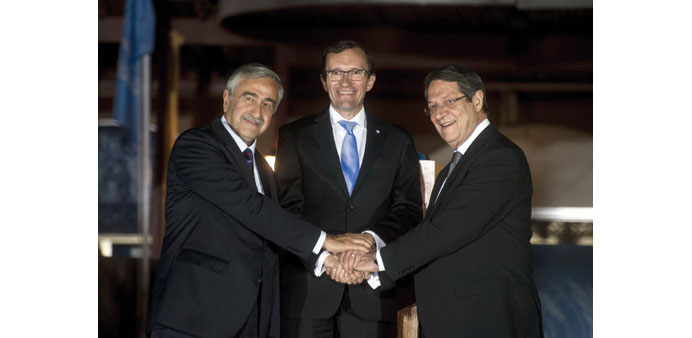
Cypriot President Anastasiades (right), Turkish Cypriot President Akinci (left), and Eide pose for a photograph following a meeting at Ledra palace la