


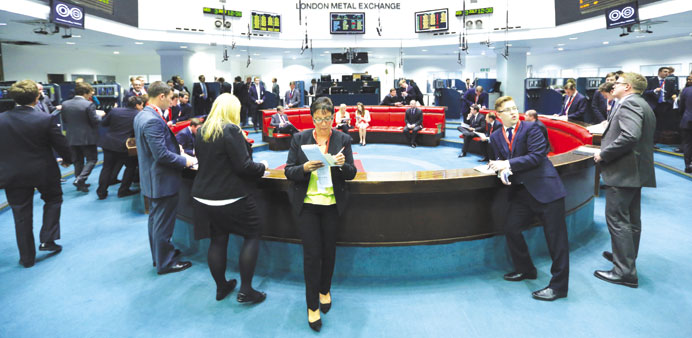
Traders stand outside the open outcry pit following a trading session at the London Metal Exchange. Lead is the best performer so far this year on the LME up by over 2% and right now it is clinging to support around the $1,900 level.
By Andy Home/London
The average daily London Metal Exchange (LME) stocks report showed a whopping delivery of 32,600 tonnes of lead onto warrant at the Dutch port of Vlissingen.
This is not entirely surprising.
The market has been looking for metal to resurface ever since the mass raid on LME inventories back on March 20.
What is surprising, though, is the location of yesterday’s inflow since the LME “Street” had convinced itself the metal was heading to South Korea.
It’s possible that some has been diverted. It’s also possible that the Dutch arrivals are completely unconnected with what happened back in March.
Either way, the jump in exchange stocks doesn’t bode well for the lead price.
Lead has been the out-performer among the core LME base metals ever since those March cancellations.
But three-month metal has already fallen a long way back from its May peak of $2,162 per tonne and at a current $1,910 it is looking decidedly vulnerable.
The March 20 cancellation of 98,350 tonnes of lead, equivalent to around 40% of total LME stocks, shook the lead market out of its previous apathy and sent it on a $450 rally that topped out in early May.
True, no-one actually thought any of this metal was going to meet manufacturing demand. The sheer scale of those cancellations suggested rather the sort of storage arbitrage that has come to characterise other surplus markets such as aluminium and zinc. But the prospect of 40% of LME stocks disappearing into the statistical ether wasn’t exactly price neutral either.
The puzzle has become a little more complex in the intervening period, since at least some of the lead cancelled in March wasn’t loaded out at all but was instead put back onto LME warrant.
This is particularly true of the two Spanish locations, Bilbao and Barcelona, where a total 18,775 tonnes were cancelled but only 4,125 tonnes has actually been drawn down. Indeed, between them they have actually received more lead than has been loaded out over the course of the last two months. It is also partly true of Vlissingen, which has also seen significant “reverse cancellations” after the March raid.
And Vlissingen, where LME warehousing is dominated by Pacorini, the logistics arm of physical power house Glencore, is where 32,600 tonnes has re-appeared.
Or maybe just “appeared” since the market thought it knew exactly where all that lead was being taken by a rival merchant, namely South Korea.
The only question was whether it would go back onto LME warrant or sit off-warrant in a discounted storage deal.
Now there is another question. Is the inflow at Vlissingen in part the same metal that was sucked out of the LME system after March 20 or is it completely unrelated?
That’s the tricky thing with LME stock movements. They can deceive as much as they can inform.
If the mass cancellation of lead in March was the prime reason for the recent rally, and there’s not been much else to help explain it, then a sharp turnaround in the stocks trend risks sending the price back to where it started, all the way down to the $1,700 level.
Something similar has recently played out in the zinc market where a steady downtrend in LME stocks fanned the flames of a price rally, only for zinc bulls to be sent scuttling by a 37,375-tonne flurry of warranting at the Malaysian port of Johor.
Lead is still the best performer so far this year, up by just over 2%, but right now it is clinging to support around the $1,900 level.
Market open interest on the $1,875 strike currently stands at 1,040 lots (26,000 tonnes) and that on the $1,850 strike at an even larger 2,856 lots (71,400 tonnes).
Those options will be settled on the first Wednesday of July, meaning July 1. That day was valued at $1,913 as of yesterday’s close. If the price drops through $1,900 between now and then, those options positions could act as accelerators, with delta-hedging by market-makers exacerbating other selling pressure.
This market, in other words, is very delicately poised above a technical chart void in which sit potentially powerful options magnets. LME stocks are what started lead on its upwards journey and LME stocks, it seems, will determine what happens next.
It all depends on what else “turns up” in the LME warehousing system over the next couple of weeks. The London market really thought it knew the answer to the lead stocks puzzle.
Today’s warrantings at Vlissingen, however, have complicated things and the market is back to where it started, trying to second-guess the actions of some of the world’s biggest physical lead players.
*Andy Home is a columnist for Reuters. The opinions expressed are his own.