


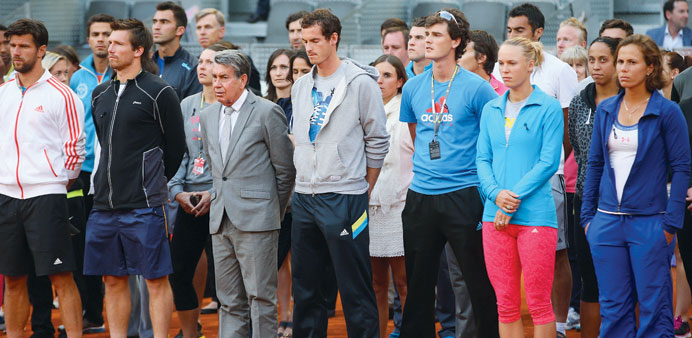
Andy Murray (centre), his brother Jamie Murray, Manolo Santana, Caroline Wozniacki of Denmark and other players and officials stand for a minute's silence in memory of former tennis player Elena Baltacha during the Madrid Open in May. Baltacha, who was Britain's number one women's tennis player during her playing days between 2002 and 2010, died of liver cancer in May at the age of 30.
Andy Murray has opened up to talk about how the death of Elena Baltacha and the cancer diagnosis of his friend Ross Hutchins have affected him.
The world No. 2 admitted that Baltacha’s death last year from liver cancer at the age of 30 is “hard to process, even now” but added that it had spurred him to step up his charity work, from the Rally for Bally events for cancer care to his Unicef role helping its work with refugees.
Writing on the Players’ Tribune website, Murray, who is preparing for next week’s ATP World Tour finals in London, said: “I did not know Elena as well as I knew Ross, but still, in the tennis community, you ‘know’.
“Tennis is a small community, a small world. And in small worlds, you usually get a good sense of what everyone is like.
“You hear things. And trust me: When someone is a ‘bad apple’, in any way, you’re definitely going to hear things.
“Bally—all you heard were the best things. Honestly. Just how gracious she was, how easy to work with, how nice she was to anyone she interacted with. Bally was just … a good person. She was, like Ross, ‘one of the good ones.’ My mum coached her from a young age and was very fond of her. We all were.
“When she succumbed to it and died at 30, it was a shock beyond shock. I could try to find the words … but I wouldn’t manage. It’s hard to process, even now.”
His long-term friend and hitting partner Hutchins, who was diagnosed with Hodgkin’s lymphoma at the age of 28—the same age Murray is now—has since recovered but Murray said it has jolted his “false sense of security” about cancer diagnosis.
“I remember my exact internal reaction when I found out the news,” Murray wrote.
“It wasn’t stress. It wasn’t sadness. It was: Sorry, what? It was disbelief. It was total, utter disbelief.
“You mean Ross, as in … Ross? You mean Hodgkin’s lymphoma, as in … cancer? In the back of my mind, I honestly just don’t think I believed it was true.
“Ross is one of my best friends for a reason. You know how you have your ‘sometimes’ friends? The friends where, sure, they’re alright—but you have to be in a certain mood to hang out with them? Ross is the opposite of that. Ross is my ‘anytime’ friend: someone whom I’ve always wanted around—and who, in turn, has always been there for me.”
The British No. 1 added: “I now view charitable activism as an essential part of my everyday life. From ‘Rally for Bally’, which has become an annual event, and other cancer-fighting initiatives; to ‘Andy’s Aces’, a Unicef initiative I’m spearheading to help with Europe’s refugee crisis; to my work with Malaria No More, to help eradicate Malaria for good; to my work as a global ambassador for the World Wildlife Fund and United for Wildlife—these efforts have shaped who I am, and represent who I want to continue to become.”
Murray faces a busy month ahead on court, with next week’s ATP World Tour Finals at London’s 02 Arena followed swiftly by the Davis Cup final against Belgium, which starts on November 28. (The Guardian)