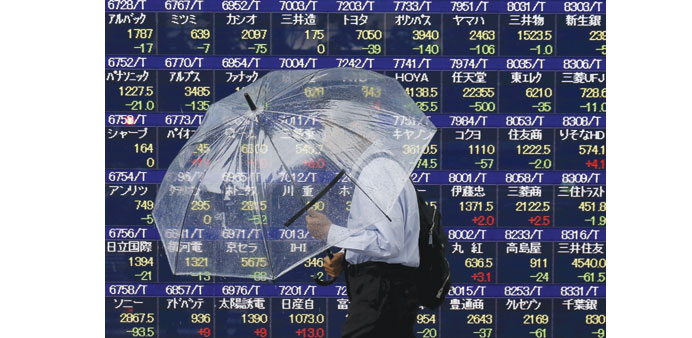

A man holding an umbrella walks in front of an electronic stock quotation board in Tokyo. Japan’s main exchange-traded fund, the world’s largest, has become so popular with an investment mandate to double returns that it is distorting the Tokyo futures market and exposing stocks to unexpectedly large price swings. With turnover now more than 400 times at its launch, the Nomura Nikkei leveraged ETF is posing a tricky problem for the fund’s manager, Nomura Asset Management.
Reuters
Tokyo
Japan’s main exchange-traded fund, the world’s largest, has become so popular with an investment mandate to double returns that it is distorting the Tokyo futures market and exposing stocks to unexpectedly large price swings.
With turnover now more than 400 times at its launch, the Nomura Nikkei leveraged ETF is posing a tricky problem for the fund’s manager, Nomura Asset Management.
Japanese day traders and professional players such as high-frequency traders have been lured by the fund’s aims to double the Nikkei stock index’s moves in either direction.
The rapid growth has meant a huge number of futures must be bought or sold to deliver the fund’s mandate - an amount so high that it has at times begun to distort the futures market and shake up the Nikkei.
Nomura’s efforts to smoothen the wild swings by stopping the creation of new shares in its existing funds have led to more distortions. “The simplicity of the ETF is blinding people to think they are safe. (In reality), the complexity of ETFs is misunderstood by investors,” Michael Newman, the president of Analogica KK.
The ETF is by far the most actively traded instrument on the stock exchange, with its daily turnover routinely surpassing big cap shares such as Toyota Motor and Mitsubishi UFJ Financial.
It has racked up a daily turnover of about ¥220bn ($1.70bn) on average during the last three months, up from a low of ¥500mn at its launch in April 2012.
The safety of ETFs came under scrutiny in the US after many of them suffered flash crash-like falls on August 24 when panic over China hit Wall Street.
A quick look at the numbers provide a snap shot of the risks and rewards of this trade.
To produce twice the Nikkei’s daily return, Nomura needs to hold in futures twice the amount of its total assets, so about ¥1.64tn for the ¥820bn fund – the worlds’ largest leveraged ETF.
This means for every percentage point rise in the Nikkei, Nomura needs to buy an extra 2% of its total asset in Nikkei futures.
That is fine when the Nikkei does not move much, but a fall of 3%, for instance, would require Nomura to sell almost 50bn yen of futures – an amount big enough to hit an already fragile stock market.
Indeed, on August 24 when the Nikkei tumbled 4.6% at one point on concerns about cooling growth in China, traders blamed leveraged ETFs for exacerbating the selloff.
While such swings aren’t unusual, traders warn the futures market may no longer be able to absorb the increasingly large orders Nomura Asset needs to manage its funds, especially the mammoth Nikkei leveraged ETF.
The problem has become so great that Nomura has stopped creating new shares in it and two other ETFs – Nikkei Inverse ETF and Nikkei Double inverse ETF.
The former is designed to produce the opposite return of the Nikkei, and the latter double the amount.
“We judged that the current asset size is suitable to maintain the link between the ETFs’ price and index, considering the balance with trading volume of futures,” said Kazumasa Hironaka, spokesman of Nomura Asset.
Still, while suspending the creation of new shares gives Nomura some leeway, it is creating another quandary.
Arbitrage players, who try to profit by taking advantage of small discrepancies between these leveraged ETFs and the Nikkei, are finding it harder to trade because of the lack of new shares.
Consequently, leveraged ETF prices have lost their link with the Nikkei, which they have to track.
For instance, the Nikkei Double Inverse ETF, which is meant to double the Nikkei’s moves in the opposite direction, has risen on days it should have fallen because retail investors bought them as hedge against future falls.
On November 11, the Nikkei rose 0.1% and the fund rose 0.4% when it should have fallen 0.2%.
It rose 0.8% the next day, when the Nikkei was almost flat.
“Of course, nobody will complain when ETF price rises,” said a fund manager at a Japanese asset management firm.
“But this means the opposite could happen. The stock market falls and the price of the inverse ETF falls. That would be quite horrible.”