
AFP/Cairo
Egypt’s military rulers have decided to hold parliamentary elections, scheduled for September up to two months later, a military official told state media yesterday.

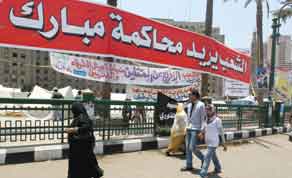
Egyptians walk under a banner reading in Arabic ‘The people want trial for Mubarak’ during protests at Cairo’s Tahrir Square yesterday
“It has been decided to hold elections for the People’s Assembly and the Shura Council next October or November,” MENA state news agency quoted the official as saying, in reference to the lower and upper houses of parliament.
The official said the Supreme Council of the Armed Forces - which took power when president Hosni Mubarak was ousted in February - “is committed to its previous announcement that the electoral process would start six months from the constitutional declaration” of March.
“This means that the electoral process for the People’s Assembly and the Shura Council would start before the end of September,” the official said.
The process - including presentation of candidacy, campaigning, fixing voter registration lists and defining constituencies - would “take no less than 30 days and up to 50 or 60 days which is why elections would be held in October or November,” he said.
Previously, the military council had clearly set out its timetable stating parliamentary elections would be held in September, followed by the drafting of a constitution and that a date would then be set for presidential elections.
On March 28, General Mamduh Shahin, a member of the council, told reporters that “the legislative elections will be held in September.”
The debate on whether or not to delay the elections had been debated for months, with some calling for elections to be postponed in order to give new groups more time to get organised.
In March, 77% of Egyptians voted in favour of holding an election first and having the new parliament draft a fresh constitution.
The Muslim Brotherhood had thrown its full weight - and organisational skills - behind a “yes” vote because a September poll was expected to boost the group.
Some groups had expressed concern that having the poll first would result in the Islamist group having too much influence over the constitution.
But others wanted to push ahead with elections to have the ruling military council - which they see as an extension of the old regime - out of power as soon as possible.
The announcement comes as thousands have camped out across the country since nationwide rallies on Friday to demand political change.
At Cairo’s Tahrir Square, protesters vowed to pursue their sit-in despite warnings from the ruling military council.
Hundreds spent another night in Tahrir - the epicentre of protests that toppled Mubarak - where they have been camping out since nationwide rallies on Friday to demand political change.
Tarek Mehanna, 32, said demonstrators would “stay until all the demands are satisfied, not only four or five of them.” Some say they have lost confidence in the SCAF. “In six months, nothing has happened,” said George Ikram, 18.
Activists say the uprising’s central demands - which include an end to military trials of civilians, and speedy and open trials of former regime officials and police officers accused of abuses - have been ignored.
They also want to remove former regime officials from state institutions.
In a stern television address on Tuesday, SCAF member Mohsen Fangary warned protesters not to “deviate from the peaceful approach during demonstrations and sit-ins, or obstruct the institutions of the state.”
General Mamduh Shaheen, another SCAF member, later said the army would “not use force against protesters but will be firm in dealing with all sabotage attempts.”
The warnings seemed to only spur the protesters’ resolve to pursue their sit-ins, and prompted thousands to chant for the downfall of the military council’s chief, Field Marshal Hussein Tantawi - Mubarak’s longtime defence chief.