


Real Madrid’s president, Florentino Pérez, did not accept questions when he appeared at the Santiago Bernabéu to announce the sacking of Rafa Benítez and the appointment of Zinedine Zidane on Monday night. Perhaps he thought there was nothing new to say. It is, after all, only six weeks since he called a press conference to denounce a “campaign” against the club and deny reports that he was contemplating making Benítez the 10th manager to leave during his presidency. Or maybe he just did not want to be asked any awkward questions, like: ‘Why?’
The frustration for Benítez may be that, if he was going to get sacked one day, he should at least have been sacked doing something he truly believed in. Instead he died with somebody else’s boots on. Benítez is a manager who demands control; at the Bernabéu he did not have it, until it was too late. Compromise did not save him and adopting his master’s voice was no protection. He had been brought in to carry out a restructuring not entirely of his own design and, when that proved problematic, it was he who paid for it.
The task set was a difficult one, always likely to end in failure. Benítez inherited a squad in which the heavyweights were so furious at the departure of Ancelotti as to say so publicly. They loved him whereas Benítez was the step-mother – a wicked one at that. His manner is to impose, to work and lay down rules, not to seek affection.
Benítez had been brought in to break from the Ancelotti model, but there were contradictions in the vision. Pérez was convinced that Ancelotti did not work the players hard enough, that they needed a leader not a friend. With a dressing room like this one that was always likely to meet with some resistance, not least as one of Benítez’s other tasks was to tilt the team’s axis towards Gareth Bale, part of the president’s longer-term strategy.
Players saw the manager’s weakness, an authoritarian with no authority. The compromise was not comfortable and ultimately it did not help. The results were poor and performances worse. Madrid have not produced 90 minutes of good football against a decent team all year; Benítez was defensive about accusations that he was defensive but in truth the charge was simpler than that: his team was just not very good. They were not even good at the things his teams are supposed to be good at.
Short-term survival could not last long term, although momentarily Benítez hoped it might have strengthened his hand. Afterwards the president said publicly that “of course” the coach had complete freedom to choose the players he wanted. As it turned out, the “so long as they’re the right ones” went without saying – publicly, at least.
Against Valencia neither James Rodríguez nor Isco played a single minute and that may have been as significant as the 2-2 draw.
The message had changed: the week before he had parroted the president’s conspiratorial line to insist that there was a campaign against him, Pérez and the club; now the analysis focused on the flaws sought on the inside. Benítez said he was looking for “balance,” just as Ancelotti had before him. In other words, this was an old problem: the president and the players. They were the problem, Benítez said. In doing so he became an even greater problem than he already was. He was no longer the solution. He never had been.
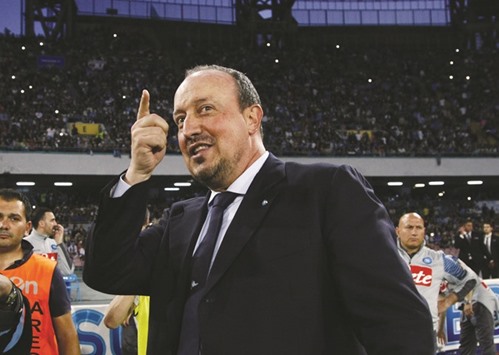
File picture of Rafael Benitez.