


Last year was painful for US companies with overseas sales as the dollar soared by the most since the 1970s. Less than one month into 2016, many of those same firms are already bemoaning the greenback’s strength and the impact on profits for this year.
“At current spot rates, we would expect a significant impact to revenue and profit again in 2016,” Martin Schroeter, the chief financial officer at International Business Machines Corp, said during a January 19 earnings conference call with analysts.
Schroeter should know. A strong dollar cut the Armonk, New York-based company’s earnings by $1bn last year and crimped revenue by about $7bn, or more than the annual sales of 200 companies in the Standard & Poor’s 500 Index. Union Pacific Corp, the largest publicly traded US railroad, has watched the rising dollar drag on carloads of steel, grain and coal for export. Wall Street analysts see even more gains for America’s currency.
The last two round of quarterly results from corporate America shows the extent of the impact. Currency fluctuations lowered earnings for the average North American company by 12 cents per share in the third quarter, according to Scottsdale, Arizona-based FiREapps, which makes software to help businesses reduce the effect of foreign-exchange swings. The lost earnings were up from 3 cents a share in the second quarter.
Earnings in the S&P 500 probably fell 6.3% in the fourth quarter of 2015 and may drop 2.5% in the current period, extending the longest streak of declines in six years. While Wall Street firms see a 4.8% rebound in full-year 2016 profits, that’s about half the growth rate they were projecting as recently as September.
A Federal Reserve index of the dollar on a trade-weighted basis jumped almost 12% last year, the biggest gain in data going back to the 1970s. The rally has hardly slowed, with the gauge reaching a 12-year high this month. The currency is forecast to strengthen 4% to $1.04 per euro by year-end and almost 6% to ¥125, according to the median estimates of analysts surveyed by Bloomberg.
The reason for the gains is two-fold: higher relative returns on dollar-denominated fixed-income assets than investors can get most anywhere else in the developed world as the Fed begins to raise interest rates; and an economy that is also doing better than many other places. Add to that rising concern China may use its currency to bolster its competitive position, which would extend the pain for US companies.
“In the run-up in particular to the rate hikes, you typically get a stronger dollar and that takes some of the steam out of earnings,” said Robert Tipp, chief investment strategist in Newark, New Jersey, for Prudential Financial Inc’s fixed- income division, which manages $565bn.
The currency effect is indirect for companies such as Union Pacific, which hauls exported goods.
Union Pacific has watched the strong dollar crimp carloads of steel, grain and coal for export, chief executive officer Lance Fritz said in a January 21 interview. Rail shipments of metals tumbled 27% in the fourth quarter, while those for grain fell 12%.
“You can clearly see the impact across commodities,” Fritz said. “The strong dollar apparently is going to remain.”
3M Co and Coca-Cola Co, which have pushed into international markets seeking growth, log reduced overseas revenue and profit when converting them back into dollars.
Even with hedges in place, 3M, the maker of Post-it Notes and surgical masks, expects currency effects to reduce 2015 earnings by 5%, or 40 cents a share. 3M hedges about 50% of its foreign-exchange exposure and adds protection on the most-traded currencies, Nicholas Gangestad, 3M’s chief financial officer, said during a December 15 conference call with analysts.
Hedging involves using derivatives positions, such as futures or options, designed to protect against currency-based losses. While offsetting potential damage, these positions are costly and may also preclude currency-based windfalls from beneficial foreign-exchange swings.
Strong-dollar concerns have joined the oil-price drop and slowing global economic growth to weigh on stock prices, said Nick Heymann, an analyst with William Blair & Co in New York who covers industrial companies. Investors are watching the yuan and the possibility China will use the currency to boost its competitive position, he said.
The effects of the strengthening dollar “should diminish and be about half the problem this year, unless we get into some currency wars, and that in turn could blow this back up as a big problem,” Heymann said. “People just don’t know.”
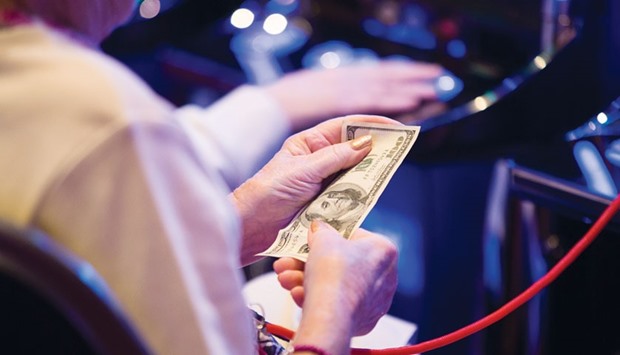
A woman holds a one hundred dollar bill at a shopping centre in Plainville, Massachusetts, US. A Federal Reserve index of the dollar on a trade-weighted basis jumped almost 12% last year, the biggest gain in data going back to the 1970s. The rally has hardly slowed, with the gauge reaching a 12-year high this month. The currency is forecast to strengthen 4% to $1.04 per euro by year-end and almost 6% to u00a5125, according to the median estimates of analysts surveyed by Bloomberg.