


 |
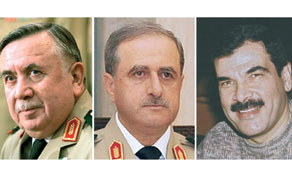
| General Hassan Turkmani, Defence Minister Daoud Rajha and Assef Shawkat: killed in bombing |
A bomb struck at the heart of Syria’s senior command yesterday, killing at least three of President Bashar al-Assad’s top brass in an attack claimed by rebels, who warned of more carnage to come.
The explosion, blamed on a bodyguard attending a meeting of security chiefs at their Damascus headquarters, prompted the White House to say Assad was “losing control” of his country.
The attack, the first to target Assad’s inner core since a 16-month uprising erupted, came ahead of a showdown between the West and Russia and China over a draft UN resolution calling for sanctions.
That vote appeared to have been delayed by a day until today.
The bombing killed Defence Minister General Daoud Rajha, Assad’s brother-in-law Assef Shawkat and General Hassan Turkmani, head of the regime’s crisis cell on the uprising, state media said.
Among those wounded were Interior Minister Mohamed al-Shaar and General Hisham Ikhtiyar, head of National Security.
Conflicting accounts have emerged of who carried out the attack and how.
It was claimed by the rebel Free Syrian Army as its fighters battled Assad loyalists across Damascus for a fourth straight day, although another group, the Brigade of Islam, also said it was responsible.
The FSA command “announces the good news of the outstanding operation this morning that targeted the National Security headquarters and the killing” of the officials “responsible for barbaric massacres”, it said.
The rebels said the attack, part of Operation Damascus Volcano launched on Monday, “is the first in a series... aimed at bringing down Assad and the pillars and symbols of the regime, whether civilian or military”.
State media initially said it was a “suicide bombing” before apparently retracting and calling it a “terrorist attack”.
A Syrian security official said the bombing was carried out by a bodyguard of one of the ministers or security chiefs at the meeting. The attacker had been wearing an explosives belt.
Another official said the blast was caused by a briefcase packed with explosives that a bodyguard left in the meeting room and detonated from afar via remote control.
The FSA said in a YouTube video that six people died including Interior Minister Shaar, General Hisham al-Bikhtyar, head of the national security branch, and Mohamed Saeed al-Khitan, identified as “deputy local trustee”.
Rajha, a Christian, was the highest-ranking officer in the army under Assad’s overall command.
The Syrian Observatory for Human Rights called Shawkat’s death “a severe blow to the Syrian regime since he played the main role in operations by regular forces to crush the revolution”, notably in flashpoint Homs province.
State media said Assad appointed General Fahd al-Freij as new defence minister, and he promptly appeared on television vowing to “hunt down criminal gangs and cut off the hand of those who threaten security”.
The Syrian army said the “terrorist act increases the armed forces’ determination to cleanse the country of terrorist groups”.
News of the bombing was greeted with joy in Jabal Shahshabu, a rebel stronghold in central Syria where people fired Kalashnikov assault rifles into the air and shouted “Allahu Akbar”.
In neighbouring Lebanon, a child was shot dead following similar celebrations in the northern city of Tripoli, scene of frequent Syria-linked clashes.
The blast came a day after the FSA—comprising army defectors and armed civilians—declared its battle to “liberate” Damascus had begun and warned the regime to “expect surprises”.
Columns of black smoke rose over Damascus as troops shelled Qaboon and Barzeh, while fighting raged in Al Midan and Zahira and loud explosions were heard in Mashrou-Dumar, said the Local Co-ordination Committees.
The Observatory said violence across Syria had killed at least 100 people so far yesterday, among them 19 people in Damascus, including the security chiefs. All but one of the rest were civilians.
White House National Security Council spokesman Tommy Vietor said Assad was “losing control”, pointing to “increasing” defections and a “strengthened and more united” opposition.
Pentagon chief Leon Panetta said the international community must “bring maximum pressure on Assad to do what’s right, to step down and to allow for that peaceful transition”.
EU foreign policy chief Catherine Ashton said the bombing “underlines the urgent need for concerted action by the UN Security Council and the international community to enforce Kofi Annan’s peace plan”, referring to the UN-Arab League envoy.
Russia demanded the arrest and strict punishment of those behind what it called an “act of terror”.
“We see the events as another attempt to further destabilise the situation in Syria,” the foreign ministry said, calling on both sides to reassess the situation and seek peace.
The Kremlin said Russian President Vladimir Putin and US counterpart Barack Obama were unable to resolve their differences on Syria in a telephone conversation.
“Differences in approaches remain that concern practical steps in achieving a settlement,” Kremlin spokesman Dmitry Peskov was quoted as saying by Russian news agencies.