


More than 300,000 passengers were yesterday stranded in the worst rail strike for a generation.
A day of misery for Southern commuters saw platforms deserted and the equivalent of the population of Coventry forced to miss work or attempt to battle their way in.
Those trying to find alternative routes were hit by chaos on key Tube lines and gridlock on the roads. Swathes of Surrey, Sussex, Hampshire and Kent were left without any Southern trains as 1,000 drivers from the Aslef and RMT unions went on strike.
The action crippled more than 400 miles of track and 156 stations — from Portsmouth and Southampton to the south-west, Milton Keynes to the north-west, Bermondsey to the north-east and Ashford in the east. Upset members of the public described how they are losing pay, missing the chance to read bedtime stories to their children and juggling with childcare.
Passengers face the same plight again today and tomorrow, as the unions exert their grip on the lines in a nine-month dispute they say is over safety on driver-only operated (DOO) trains. As the public suffered, a political blame-game was in full swing.
In key developments yesterday morning:
l Tube services that thousands of commuters turned to in the hope of beating the strike suffered a series of breakdowns, including Victoria and Piccadilly line services.
l Transport Secretary Chris Grayling hinted at anti-strike laws — and came close to saying Southern should be stripped of its licence.
l Nick Brown, of Southern owners GTR, accused the unions of ignoring an offer of talks and “inflicting pain and suffering on our passengers”.
l Mayor Sadiq Khan said passengers had been “betrayed” and demanded to be put in charge of Southern services as an emergency measure.
l Business leaders warned that the disruption will cost tens of millions of pounds on top of the human misery.
l Greater Anglia cancelled at least 30 trains with many more delayed due to broken-down trains and faulty signals.
Mick Whelan, general secretary of Aslef, denied government claims that the strikes were motivated by politics rather than safety, when challenged over the fact that the union tolerates driver-only trains on other routes.
“We regret the action we are taking,” he said. “We don’t want to inconvenience passengers nor do our members want to lose money but we have been forced into this by a company that is not prepared to negotiate.
“The strikes this week are not, whatever Grayling tries to suggest, politically motivated. We have a trade dispute with GTR/Southern, and only a poor government would seek to spin it any other way.”
Grayling called that “palpable nonsense” and accused the unions of seeking to control the network. Asked if the government might change the law to prevent similar strikes, he said: “I think there is a lot of things after this is over that we are going to have to take a careful look at because we can’t leave our railways exposed.”
Asked on BBC Radio 4 whether Southern could be stripped of its licence, he replied: “There is a variety of things we need to think through and I am not going to set out options.”
Asked again, he said: “I am not ruling anything in or out today.” He said there were huge issues facing the railways, including infrastructure problems. “The railways have got to perform better in the future... I don’t think the railways are run in a joined-up way.”
Southern’s website said: “No Southern service operates today and you are advised not to travel.” Even tomorrow when there is no drivers’ strike, an ongoing overtime ban will again decimate services with trains cancelled, starting late and finishing early. A further six consecutive days of strike action are planned from January 9.
The Gatwick Express was operating but with half the service — trains every 30 minutes instead of 15 minutes and only between Victoria and the airport.
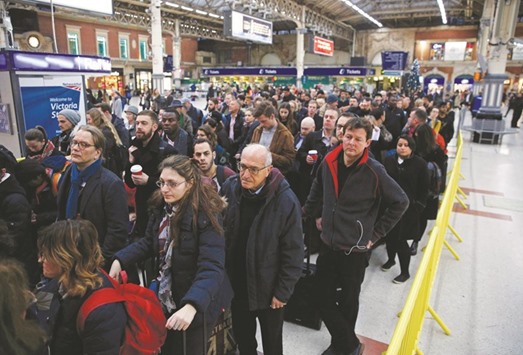
Passengers queue for a reduced Gatwick Express service during the Southern railway strike at Victoria station in London yesterday.