


After a meeting at the White House in Washington, Palestinian President Mahmoud Abbas and US President Donald Trump yesterday vowed to bring about an “historic” deal to end the Palestinian-Israel conflict.
“We will get it done,” Trump told reporters with Abbas at his side. “We will be working so hard to get it done.
It’s been a long time. But we will be working diligently.”
Abbas told Trump: “I look much forward to working with you in order to come to that historical agreement, historic deal to bring about peace.”
Trump called on Palestinians to renounce violence and to unite both Fatah and Hamas to negotiate with Israel. “There could be no lasting peace unless the Palestinian leaders speak in a unified voice against incitement to violence and hate,” Trump said.
“There’s such hatred, but hopefully, there won’t be such hatred for very long. We must be taught to value and respect human life and condemn all of those who target the innocent,” he said.
It was the first time that Abbas had visited the White House in 24 years.
In calling for an historic peace deal, Trump evoked previous White House meetings where Israel-Palestinian agreements had been formally reached.
“It was on these grounds that President Abbas stood with a courageous peacemaker, then-Israeli Prime Minister Yitzhak Rabin,” Trump said. “Here at the White House, President Abbas signed a declaration of principles, very important, which laid the foundation for peace between the Israelis and Palestinians.” Abbas said, however, that there could be no peace with the establishment of a secure Palestinian state.
“Our strategic choice is to bring about peace based on the vision of the two-state [solution], a Palestinian state with its capital of East Jerusalem that lives in peace and stability with the state of Israel based on the border of 1967,” he said.
Abbas praised Trump as a “deal maker” who could make it happen. “I believe that we are capable under your leadership and your stewardship and your wisdom as well your great negotiating ability, I believe with the grace of God and with all of your effort, we believe that we can be partners, true partners to you to bring about a historic peace treaty,” he said.
Trump and Abbas were to spend much of the day together at the White House.
The US president was expected to press Abbas to end payments to families of imprisoned Palestinians and to renounce what the US and Israel see as Palestinian “incitement” to violence, but which Palestinians see as resistance to Israel’s brutal occupation.
Trump has also spoken out, as previous American presidents have, against continued Israeli settlements that are colonising the West Bank.
Whether Trump follows up with pressure on Israel using the vast leverage America has over Israel remains to be seen, however.
Trump has been an outspoken supporter of the government of Israeli Prime Minister Benjamin Netanyahu, considered by many analysts to be the most repressive against Palestinians in decades.
Trump told Abbas: “I want to support you in being the Palestinian leader who signs his name to the final and most important peace agreement that brings safety, stability, and prosperity to both peoples and to the region.”
But Trump added that any agreement “cannot be imposed by the United States, or by any other nation. The Palestinians and Israelis must work together to reach an agreement that allows both peoples to live, worship, and thrive and prosper in peace.”
Solidarity with prisoners in Israeli jails
The Palestinian embassy in Doha organised yesterday a stand of solidarity with the Palestinian prisoners in Israeli jails, as the prisoners continue the battle of freedom and dignity (the battle of empty stomachs) by continuing their hunger strike.
Dr Yehia Zakaria El Agha, first counsellor, charge d’affaires of the embassy, said this stand is an expression of the full support of these prisoners, who suffer from positive hunger and defy the Israeli occupation with their empty stomachs.
Speaking to Qatar News Agency, El Agha hailed the firm position of HH the Emir, government and people of Qatar in supporting the Palestinian people politically, socially and economically and in all international and regional forums, [the position] which has been and continued to be in support of the Palestinian just cause.
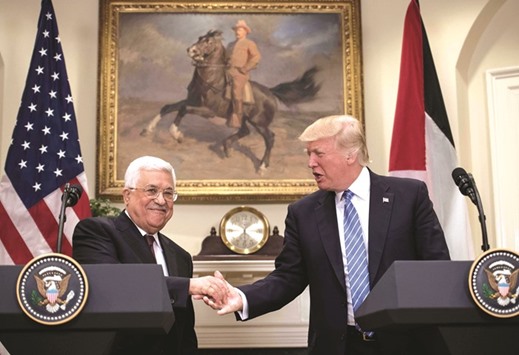
US President Donald Trump and Palestinian President Mahmoud Abbas shake hands in the Roosevelt Room during a joint statement at the White House in Washington, DC, yesterday.