


Indian stocks set a record again as the Sensex yesterday went higher by 58 points to 31,805 and the Nifty closed above the 9,800 points mark ahead of key macroeconomic data, lifted by banking, oil and gas and auto stocks.
Oil marketing companies soared on the back of higher crude oil prices. But investors were guarded ahead of release of index of industrial production (IIP) for May and consumer price (CPI) inflation for June post market hours.
The next triggers are a set of corporate quarterly earnings, which is going to kick off tomorrow with TCS. The BSE barometer closed at a new closing high of 31,804.82, up 57.73 points, or 0.18%, as fag-end buying in heavyweights emerged.
It had rallied 386.45 points in the previous two sessions. The 50-share Nifty ended up 30.05 points, or 0.31%, at a new closing peak of 9,816.10. During the session, it shuttled between 9,824.95 and 9,787.70. Its previous closing high was 9,786.05 hit on Tuesday.
“Market started positively, but consolidated near its peak as investors took a wait and watch approach ahead of CPI and IIP data. Quarterly results and their impact to the current high valuation will be eagerly watched,” said Vinod Nair, Head of Research, Geojit Financial Services.
Reliance Industries, the biggest company by market capitalisation, rallied 1.02% to hit a fresh nine-year high after its subsidiary Reliance Jio yesterday unveiled new tariff plans. HUL led the gainers list in the Sensex heatmap by surging 2.04%.
ONGC was up 1.59% on reports that the proposed ONGC-HPCL deal will be completed by the end of 2017-18. Other contributors were ICICI Bank, SBI, Tata Motors, PowerGrid and NTPC.
However, the largest IT exporter, TCS fell 1.29% ahead of its earnings, to be released today.
Foreign portfolio investors (FPIs) bought shares worth a net Rs182.05 crore while domestic institutional investors (DIIs) net purchased Rs335.75 crore yesterday, as per provisional data.
Stocks of liquor companies were back in demand after a favourable Supreme Court order yesterday. Hong Kong’s Hang Seng rose 0.64% while Japan’s Nikkei fell 0.48%. Shanghai Composite shed 0.17%. In the eurozone, shares were higher as investors looked forward to the earnings report and monitored the latest political developments in the US.
Among sectoral indices, BSE oil and gas gained the most by rising 1.54%, followed by PSU, banking and power. In sync with the overall trend, broader markets showed firmness.
Meanwhile the rupee closed marginally stronger against the US dollar ahead of the key consumer price inflation and industrial production data.
The rupee closed at 64.54 a dollar, up 0.09% from its Tuesday’s close of 64.59. The rupee opened at 64.52 a dollar and touched a high and a low of 64.49 and 64.58, respectively.
The 10-year bond yield closed at 6.459%, compared to its previous close of 6.485%. Bond yields and prices move in opposite directions.
According to Bloomberg poll, the CPI for June will be at 1.67% from 2.18% a month ago while IIP will be 1.7% in May versus 3.1% in April.
Traders are cautious ahead of the testimony from Federal Reserve Chair Janet Yellen and reports of Donald Trump Jr’s contact with a Russian lawyer.
The catalyst was the release of emails by the president’s son that said the Russian government backed his father’s presidential campaign and was trying to damage Hillary Clinton, Bloomberg reported.
So far this year, the rupee has gained 5.18%, while foreign investors bought $8.26bn and $14.64bn in local equity and debt markets, respectively.
Asian currencies were trading higher. South Korean won was up 0.5%, Japanese yen 0.41%, Taiwan dollar 0.34%, Thai Baht 0.28%, China renminbi 0.21%, China Offshore 0.17%, Indonesian rupiah 0.16%, Philippines peso 0.14%, Singapore dollar 0.1%, Malaysian ringgit 0.07%.
Rupee may weaken further, says HSBC
Bloomberg
Mumbai
The Indian rupee may weaken as global funds start to hit buying limits for the nation’s debt and valuations for equities look expensive, according to HSBC Holdings.
“I won’t be surprised if we drift down to 65-65.25 to the dollar over the next two months,” Pradeep Khanna, HSBC’s head of global markets trading for India in Mumbai, said in an interview. “Equity valuations are stretched in India as company earnings haven’t changed much in the past two years while the market is much higher.”
While the benchmark S&P BSE Sensex index closed at a record high on Tuesday, foreign investors have turned net sellers of local shares in July for the first time in three months.
The withdrawals come as hawkish comments from major central banks cloud the outlook for flows to emerging markets. Overseas purchases of Indian bonds too have slowed this month.
“Clearly, a slowdown is expected over there,” Khanna said, noting that global funds, whose access to Indian debt is restricted, have “utilised about 90%” of their investment limits.
He also cited a seasonal increase in India’s trade deficit among the reasons for the rupee’s potential depreciation.
The Indian currency capped a fourth straight week of declines on Friday. It rallied 5.2% in the six months ended June 30, and was up 0.1% in Mumbai yesterday.
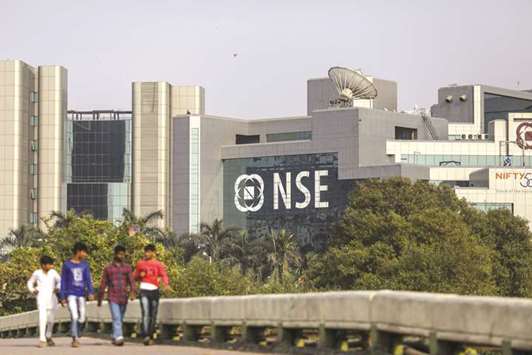
Pedestrians walk past the National Stock Exchange of India building in Mumbai. The 50-share Nifty ended up 0.31% to a new closing peak of 9,816.10 points yesterday.