


The Metropolitan Stock Exchange of India (MSEI) plans to woo brokerages to execute large stock trades on its venue, as a new management team tries to breathe life into a bourse that has floundered for a decade.
Backed by billionaires Rakesh Jhunjhunwala and Radhakishan Damani, MSEI aims to wade into the block deals segment, which is worth as much as Rs5tn ($78bn), according to chief executive Udai Kumar. India’s regulator defines a block as a single trade having at least 500,000 shares or a minimum value of Rs50mn. Money managers like dealing in large sizes because it ensures transactions are done before the market can hear about them and react by raising or lowering prices.
“We are telling institutional investors to come to our platform – there will be no slippages or price impact,” said Kumar, who was named chief executive officer last year to turn around the bourse. The MSEI is in talks with half a dozen large investment banks to bring in such deals, he said.
That’s easier said than done. Despite starting in 2008, MSEI has failed to seriously threaten its rivals. It had a 4.3% share of currency derivatives at the end of March, and barely exists in India’s $2tn equity market, which is dominated by the National Stock Exchange of India and BSE.
The company has struggled to make a mark since a payment default in 2013 at a related exchange forced the original founders to sell. A clutch of financial institutions now own more than 34% of MSEI, as do investors including Jhunjhunwala, Damani and Nemish Shah, according to bourse’s website.
Efforts are being made to fix the “erosion of trust” through investor education initiatives, broker events and media campaigns, Kumar said.
The exchange is also developing short-term debt instruments to help mutual funds and insurance companies hedge their portfolios, Kumar said in an interview at his office in Mumbai, without providing details.
“It will be an uphill task for MSEI to break into the big boys’ bastion,” said Deena Mehta, managing director at Mumbai-based Asit C Mehta Investment Intermediates and former president of the BSE. “It must find areas where the rivals don’t have a stranglehold.”
Products launches in currency, interest rate futures and corporate bonds are also planned, said Kumar. The MSEI got 250 companies to list exclusively on its venue – most of whom migrated from the 15 regional bourses the market regulator shut down three years ago – and slashed fees and transaction costs to levels it claims are the lowest in the country.
The exchange must also allow investors to buy and sell investment products on its venue to boost revenue, broker Mehta said. Both BSE and NSE run web-based order routing systems that make it easier for investors to purchase and redeem fund units on the bourses.
“It will help it become relevant and turn profitable sooner,” she said.
The MSEI, which has been making losses, expects to return to profitability by March 2020, according to the exchange. The bourse, which raised a combined Rs1.73bn via two rights issues in the past two years, is looking to garner more through the same route to bolster its balance sheet and capitalise its subsidiary, Kumar said.
Sensex rebounds; rupee ends marginally higher
Agencies/Mumbai
The BSE Sensex rebounded by 258 points yesterday and the NSE Nifty went past the 9,800-mark as metal and financial stocks led gains, tracking upbeat global cues on easing geopolitical tensions.
The 30-share Sensex closed at 31,646.46, showing net gain of 258.07 points or 0.82% as index major RIL, ITC, HDFC, L&T and HDFC Bank advanced.
The 50-share NSE Nifty reclaimed the key 9,900-mark in day trade but profit-booking at higher levels trimmed its gains. The index settled at 9,884.40, up by 88.35 points, or 0.90%.
The rally in domestic equities was largely in line with the rise seen in global stocks on signs of easing geopolitical tensions after US President Donald Trump’s measured response to North Korea missile launches.
Speculators covering up their short positions ahead of the August derivatives contract expiry tomorrow added to the gains.
Sentiment also got a boost after the GST revenue got off to a bumper start.
Finance minister Arun Jaitley said that taxes worth Rs92,283 crore were collected in July from just 64.42% of the total taxpayer base.
In the Sensex kitty, Reliance Industries emerged top performer by surging 2.12% to Rs1,564.15, followed by Adani Ports that rose 1.94% to Rs389.65.
The Sensex had lost 362.43 points in the previous session in line with a general weakness across the globe fuelled by North Korea’s missile launch over Japan.
Meanwhile the rupee yesterday closed marginally higher against the US dollar ahead of the key gross domestic product data today.
The home currency closed at 63.99 a dollar, up 0.04% from its Tuesday’s close of 64.02. The rupee opened at 63.94 a dollar and touched a high and a low of 63.88 and 64 respectively.
The 10-year bond yield closed at 6.537% compared to its previous close of 6.533%. Bond yields and prices move in opposite directions. So far this year, the rupee gained 6.3%, while foreign institutional investors (FIIs) bought $7.04bn and $19.60bn in equity and debt markets, respectively.
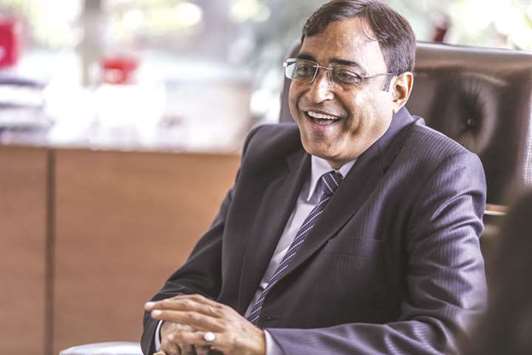
Kumar: Developing short-term debt instruments to help mutual funds.