


An Italian opera featuring symphonies of old classic composers on Sunday night kept the audience spellbound at the Qatar National Convention Center (QNCC). The night also marked the start of a month-long programme about opera music.
The more than 300 audience members in QNCC’s Auditorium III were mesmerised throughout the 2.5-hour-long performance. The programme, titled Mendelssohn’s Italian Symphony, was organised by the Qatar Philharmonic Orchestra (QPO) in line with their tradition of arranging classical Arab and European music events in Doha.
Elias Grandy, conductor of the opera, was brilliant in leading the orchestra members and creating an atmosphere of classical music. Grandy, prize-winner of the prestigious Solti competition and appointed General Music Director of the Theatre and Orchestra of Heidelberg, is quickly becoming one of the rising German conductors of his generation, according to the pamphlets distributed among the audience for introduction of the opera.
“Serving for several years as Kapellmeister at the Staatstheater Darmstadt, he has acquired a large repertoire ranging from Mozart to the contemporary composers,” said the pamphlet.
He studied conducting in Berlin at the renowned Hochschule fur Musik Hanns Eisler with Professor Hans-Dieter Baum and took part in master classes with distinguished conductors such as Fabio Luisi and Gianluigi Gelmetti. He was invited several times to conduct on Rolando Villazon’s TV show, Stars of Tomorrow, broadcast on the German/French channel ARTE.
Germán Díaz Blanco performed as the oboe player for the orchestra.
Born in Santa Cruz de Tenerife in 1986, Blanco started his music studies when he was eight at the professional conservatory of Tenerife and later he joined the orchestral academy of the Tenerife Symphony Orchestra.
He continued his studies at the Reina Sofia Music School in Madrid under the tutoring of Professor Hansjorg Schellenberger in 2005, where he also received oboe master classes from Alex Klein, Maurice Bourgue, Ingo Goritzki, Albrecht Mayer and Stefan Schilli.
The orchestra started their show with Gioachino Rossini’s well known composition of The Thieving Magpie (La gazza ladra) Overture.
Italian composer Rossini (1792-1868) wrote his first opera by age 14 and by the end of his life, he had written a total of 40 operas that inscribed his name brightly in the sky of opera. He raised the Italian lyrical art to one of its peaks, especially with his Barber of Seville, and he gave the French musical scene a new momentum during his stay in Paris.
Rossini wrote a number of semiseria operas such as L’inganno Felice and Matilda di Shabran, but his famous Gazza Ladra (or The Thieving Magpie) was composed in 1817, a year that saw the creation of other masterpieces, La Cenerentola and Armida.
The second composition that the orchestra played was titled as Concerto in D Major for oboe, AV 144, TrV 292, composed by Richard Strauss.
Strauss (1864-1949), a German composer and conductor, had a long, flourishing life. He lived at the junction of many eras of music history.
His composition, Concerto in D Major for oboe, AV 144, TrV 292 is a story regarding the coming of American army to the Bavarian town of Garmisch where Strauss resided.
The final composition that the orchestra played after the interval was composed by Felix Mendelssohn and titled as Symphony No. 4 in A Major, Op. 90 (Italian).
Most commonly known today as Felix Mendelssohn (1809-1847), a composer of the beginning of the romantic era, Mendelssohn was one of the biggest musical geniuses of the nineteenth century from Italy.
His composition has always been much appreciated and played by all known opera singers.
Audience members appreciated the classical opera music and said that though only a few could understand and follow the music and the stories in the compositions, it was very good to have the European classical music in Doha.
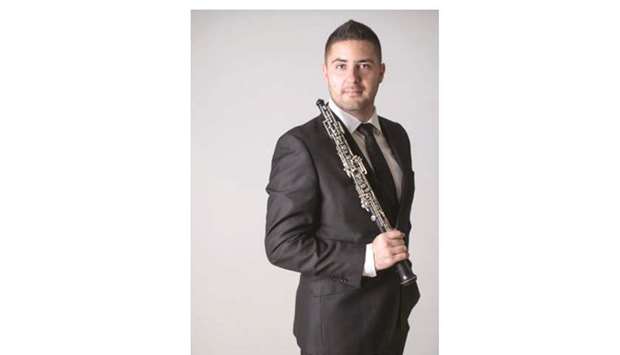
Germ?n D?az Blanco performed as the oboe player for the orchestra.