

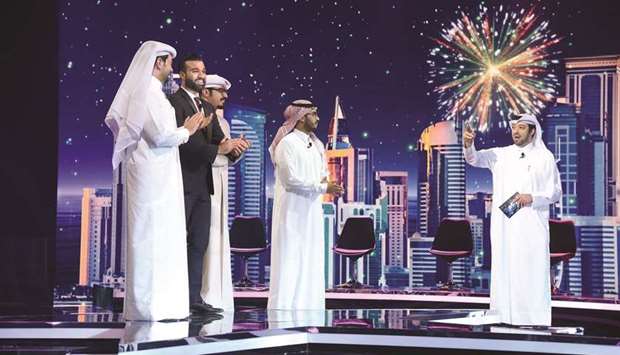
Stars of Science fans cast their votes online for one of the four finalists.
The online voting from the public, combined with the expert jury vote, earned Maksoud a score of 43%, enough to win the prize of $300,000 for his Nano-shielding Textile Machine.
The multifunctional machine harnesses nanotechnology to make clothing waterproof, integrate healing medicine into the fibres of bandages and do more.
Ahmad Nabeel, inventor of the Virtual Beam and Self-Cleaning Laparoscope, an automated, self-cleaning laparoscope with a virtual beam – making surgeries safer for both doctor and patient – came second with a combined score of 30%, earning him $150,000.
Meshal Alshahrani came in third with a score of 14.7% with his Hajj Navigation Bracelet, which will direct Muslims to important places during the pilgrimage. He won $100,000.
Mohamed al-Jefairi came fourth with a score of 12.3% with the Deaf Interactive Robotic Teacher, a device with the latest technological advancements to teach sign language to children. He was awarded $50,000.
“I am beyond humbled and hugely grateful to my mentors and fellow competitors who have made this journey both life-changing and invaluable. Stars of Science has given me the confidence and knowledge to fearlessly pursue my dreams,” said Maksoud, winner of Stars of Science Season 9.
Omran Hamad al-Kuwari, executive director at the CEO Office, QF, commented, “Stars of Science serves as a platform to launch the careers of talented young Arab men and women who possess the potential to impact their local community and beyond. This year, we have seen a multitude of incredible inventions designed to address the needs of, and solve problems specific to, the Arab world.”
The Stars of Science finale took place in Oman. Arab youth worldwide are encouraged to apply for the next season of Stars of Science.
Online applications will close on December 1.