


Ireland’s prime minister has said that he remains concerned about the Irish border after Brexit, saying that Theresa May still does not recognise the consequences of leaving the customs union and single market.
Leo Varadkar said May had given “some important reassurances” on the Good Friday agreement and the border in her speech on Friday, but they urgently needed to be backed up with detailed proposals.
“I remain concerned that some of the constraints of leaving the customs union and the single market are still not fully recognised,” the taoiseach said.
“We will now need to see more detailed and realistic proposals from the UK. Brexit is due to happen in a little over 12 months, so time is short,” he said.
The deputy prime minister, Simon Coveney, welcomed the UK’s reiteration of its commitment to the Good Friday agreement, but said that “these commitments now need to be translated into concrete proposals on how a hard border can be avoided”.
May has already agreed to three options for the border, two of which involve an overall UK-EU deal, or a third, bespoke solution entailing invisible electronic checks, pre-customs clearance for large traders, and waivers for small business.
Those proposals, first published in a position paper in August, were dismissed as “magical thinking” by the EU, and the Irish senator Neale Richmond said May offered no fresh detail on Friday to move any of them forward.
“It’s good that she seems to have taken the no-deal off the table, but it’s not about a soft Brexit, it’s about a workable Brexit,” he said.
The EU had raised concerns that a trade-only solution to the border issue did not take account of 142 areas, including health, security and trade, in which cross-border cooperation had flourished since the conflict ended.
In her speech, May tried to push some of the responsibility for the border back on Brussels, calling on the EU to be more flexible in its approach.
“We can’t do this [find a solution] on our own. It is for all of us to work together,” she said.
Coveney brushed aside any suggestion this was a plea for trilateral talks between Dublin, London and Brussels, saying all the negotiating would be done in the EU.
Northern Ireland’s leader of the Democratic Unionist party, Arlene Foster, welcomed May’s commitments to staying out of the customs union, while the Sinn Féin leader, Mary Lou McDonald, said proposals for a “fantasy technological” solution lacked credibility.
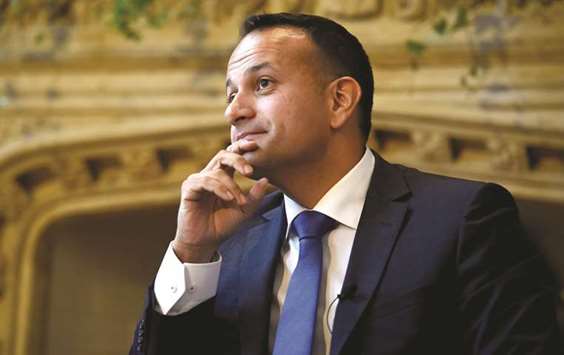
Varadkar: We will now need to see more detailed and realistic proposals from the UK.