


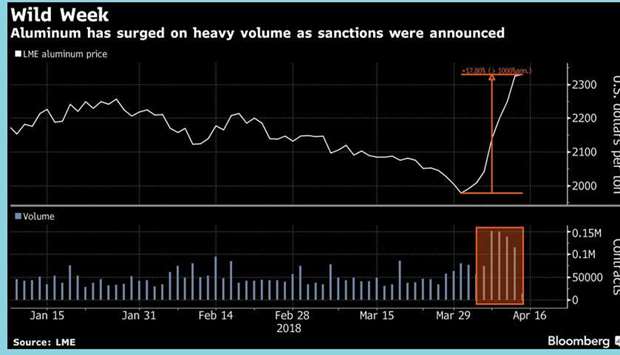
It’s been an unprecedented week for aluminium. The US’s decision to blacklist United Co Rusal, the world’s second-biggest aluminium maker, set off a rush to secure supply. Prices rose by a record this week, with ripple effects felt by car-parts makers in Atlanta, Swiss commodity traders and processing plants in the Irish countryside.
“There’s a scramble to replace Russian material with non- Russian material, which in some cases should be doable, but in others not so much,” Robin Bhar, an analyst at Societe Generale SA, said from London.
The sanctions are having an immediate and disruptive effect on global supply chains, which feed raw material into cars, planes and packaging. Rusal accounts for about 6% of the global aluminium market and is now completely cut off from the Western financial system. On Friday, Maersk Line, a unit of the world’s largest shipping company, said it will no longer accept cargo related to those on the US Treasury Department’s sanctions list.
Aluminium surged 12% last week, the biggest increase since the London Metal Exchange launched the current version of the contract in 1987. On Friday, prices retreated from near a six-year high as the metal fell by 1.7% to settle at $2,285 a metric tonne in London.
“Everybody’s been forced to take a hard look at aluminium,” said Fiona Boal, the director of commodity research at London-based Fulcrum Asset Management LLP, which has $7bn under management. “We haven’t seen that contagion risk for a number of years.” Analysts at ICBC Standard Bank said they don’t expect a sudden shortage of primary aluminium worldwide, but the impact will be in regional premiums and more specialised downstream markets.
“Exactly how the aerospace, packaging, electronics and, to a degree, automobile consumers of Rusal material resolve this problem is currently very unclear,” the analysts said.
Here’s how the sanctions are already affecting the market:
Stockpiles grab: Customers fearing a supply crunch are snapping up stockpiles on the LME. On Friday, cancelled warrants rose 35% to 370,350 tons, the biggest increase since 2011. The measure tracks orders for aluminium in warehouses monitored by the exchange. “We are not sure how Rusal’s supply will come back into the market,” said Cameron Karami, an analyst at Natixis SA in London. “Short-term inventory will get drawn down.”
Premiums skyrocket: One example of customers rushing for material - the US premium, a measure of the cost to secure LME aluminium and ship it to the Midwest, jumped this week by the most on record.
The duty-paid premium by consumers to suppliers surged to a range of 21.75 cents to 23.55 cents a pound, according to Austin, Texas-based researcher Harbor Intelligence, up from a prior range of 17.25-18 cents.
Rivals benefit: Rusal’s competitors have climbed since the US sanctions were announced late last week. Alcoa Corp and Century Aluminum Co are among the US-based winners with gains this week of 14% and 8.1%, respectively, while Norsk Hydro ASA is up 13%.
Spreads blow out: The structure of the aluminium market has flipped into backwardation. The rush to secure metal from the exchange has pushed aluminium for delivery now above prices further in the future. One-year metal is $87 a ton more expensive than one-month, the most since 2007.
Alumina leaps: The price of alumina, the key ingredient for making aluminium, is approaching an all-time high. Rusal declared force majeure on some alumina shipments on Thursday.
alu