


Most visitors to North Africa spend their time touring the royal cities of Morocco or exploring the ancient temples along the Nile, perhaps on a bus tour, or inspired by classic sightseeing itineraries in travel catalogues.
But others prefer to venture off the beaten track. For them, German travel company Hauser Exkursionen has an alternative: A tour through the Algerian desert guided by real Tuareg. “This is not a hired team. They don’t do this every week or every month, and they only do it with us because we know the elders in the region,” says Ovid Jacota, CEO of Hauser.
“The tour guide is usually either a Tuareg or someone with good links to the locals who acts as a bridge-builder. This is an extremely authentic exchange between cultures.”
A desert tour with the Tuareg is perhaps towards the extreme end of the scale, but more and more travel companies are incorporating contact with locals into their itineraries, along with the usual old towns and markets.
Algeria is not the only destination offered by Hauser. The company also runs tours led by locals in Italy, “We found a fisherman, Pino, from the Aeolian Islands, who shows our guests ‘his’ Italy,” says Jacota.
Pino takes holidaymakers from island to island in his boat. “It is a way of glimpsing the Italian soul.” And that is exactly what many travellers want nowadays, at least as a supplement to the standard itinerary.
Authenticity is the magic word, according to Ulrich Reinhardt, a professor and tourism researcher with the Foundation for Future Studies in Hamburg.
“Tourists want to get to know real life. It’s about providing a contrast to everyday life at home, but also an unusual and special experience, which not everyone has. Visiting an old town can’t provide that.”
Another provider, Munich-based Marco Polo Reisen, focuses on authentic experiences, not just the usual tourist attractions. “Such experiences are lasting and emotional,” says Holger Baldus, Managing Director of Marco Polo Reisen.
“In Beijing, for instance, everyone wants to see the Forbidden City. But they already know what it looks like.” Sensory experiences leave a far longer-lasting impression in people’s minds, he says. “How did something smell? How did it taste?” He continues, “People know from the outset that standard sights are going to be great. Expectations are high from the start.” That’s why the company likes to take its customers to unexpected places, for example, on a morning bike tour of Shanghai, bang in the middle of city traffic. “You can see people doing tai chi in the park in the morning or having breakfast in their kitchens,” says Baldus, everyday life as the main attraction. “It just blows you away.”
Yet why are such experiences so in demand? Firstly, many countries have become more accessible. Twenty to 30 years ago, visitors to Nepal would have been happy to simply travel safely from one end of the country to the other. Today, that’s nothing special. Secondly, tourists are staying fitter and more adventurous for longer, so demands on organisers have risen.
Travellers want unrehearsed experiences, says Baldus, “People have become very choosy in that respect and don’t go for kitsch any more. If our guests believe the offer smacks of a promotional event, they become really angry. Our tour guide will incur their wrath if expectations are not met.”
However, the experience must not be too demanding. According to Baldus, everyday life in the host country must be brought to travellers in a measured manner.
“You have to know your limits. The pace in China is faster than in Portugal or Greece.” Moreover, travel offers that put people in touch with locals are still something for a niche target group, at least if you look at the holiday market in general.
“People who don’t want a deeper experience won’t ask for it. They don’t expect it and might not like it either,” Baldus says. And the usual sights won’t be disappearing from itineraries any time soon. “Only when the must-sees have been checked off does immersion into every day, local life begin. Every first-time visitor comes to see the highlights, it’s in the traveller’s psyche.”
The same applies at Hauser, “Authentic encounters still only play a small role,” says Jacota. “We describe 90 per cent of the trip to the customer, and 10 percent is a surprise. We’re counting on the guests to trust us.”
Planning and security are therefore top priorities. But Jacota is certain, “The need for authenticity will continue to grow.”– DPA
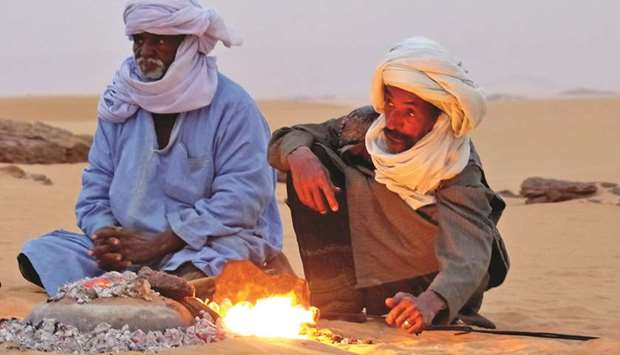
A REAL EXPERIENCE: German travel company have started offering its customers a tour through the Algerian desert guided by real Tuareg.