


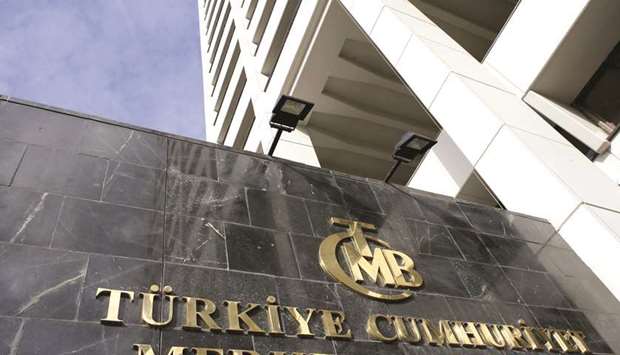
On the one hand, a steep rate increase could stem the slide in the lira that has boosted dollar-debt costs by more than 40% this year. On the other, pausing would spare the already bruised balance sheets of companies, which have had to contend with a near doubling in local borrowing costs.
“Unfortunately, there is only a bad scenario and a worse scenario for the Turkish corporate sector,” said Inan Demir, an emerging-markets economist at Nomura International Plc in London. “If the central bank delivers a convincing rate hike, the currency will stabilise. The net effect of a strong rate hike is more positive for companies.”
The lira’s plunge against the dollar in 2018, second only to Argentina’s peso, means policy makers have little choice. The central bank will probably increase its benchmark one-week repo rate by 325 basis points to 21% at its monetary policy committee meeting this week, according to the median of 23 estimates in a Bloomberg survey. Nomura’s Demir says a 575 basis-point increase is needed to bolster the currency.
The lira rallied 1.2% to 6.3562 per dollar as of 3.57pm in Istanbul yesterday, extending gains this month to 2.9%, mainly in anticipation of an interest rate hike. Still, the central bank is unlikely to do enough to stem the currency’s decline this week, even if it meets expectations for a rate increase of 325 basis points, according to Standard Chartered Plc.
Higher borrowing costs, the lira’s depreciation and a spike in inflation to 15-year highs are starting to bite, according to a business group in the town of Gebze, the nation’s third-biggest industrial zone with more than 230,000 workers and thousands of companies.
“We’ve been hearing that some of our member companies are not even able to pay their power bills,” said Nail Ciler, head of the Gebze Chamber of Commerce. “If this goes on, and no comprehensive solution backed by government support is found, we may see mass redundancies.”
The latest rout in the currency followed a row with the US over an American pastor held in Turkey for almost two years on espionage and terrorism-related charges.
Companies have come in their droves to reorganise their debt and extend loan maturities, including $6.5bn by Yildiz Holding AS, the producer of Godiva chocolates and McVitie’s biscuits, and $2.5bn by Salt Bae owner Dogus Holding AS. While most companies are able to handle refinancing risks over the next 12 to 18 months, the slowing economy and tighter liquidity conditions, could cause corporate access to loans to reduce, Moody’s Investors Service said in a report on Tuesday.
“A sequential jump of more than 7% in bad debt in June and the rising number of restructuring requests prove the weak lira is taking its toll on non-financial corporates,” said Bloomberg Intelligence analyst Tomasz Noetzel. These companies have more than $200bn of unhedged foreign-exchange positions, which might make it difficult for banks to roll over about $100bn of debt coming due in the next 12 months, he said.
“The biggest problem is in companies that import goods with foreign currencies and sell products in Turkish liras,” said Ciler of the Gebze chamber. “They just can’t cope with the mismatch.”