


Theresa May has promised MPs the chance to reject a ‘no-deal’ Brexit and possibly delay the departure date, while repeatedly declining to say whether or not she and the government would support such moves.
In a significant first concession that Brexit could take place after March 29, following months of insistence the deadline could not be shifted, May sought to appease restive Conservative backbenchers, but prompted concern from pro-Brexit MPs.
In a sign of the continued uncertainty, the cross-party backers of a plan to be debated by MPs today intended to prevent ‘no-deal’ said they would still table the amendment, pending further assurances from ministers.
Jeremy Corbyn said the prime minister was yet again trying to run down the clock to pressure parliament into backing her deal, calling this “grotesquely reckless”.
Making a statement to the Commons after her talks with EU leaders in Egypt, May reiterated her pledge to give MPs a meaningful vote on a revised Brexit deal by March 12.
If this did not happen or if it was voted down, then by March 13 MPs would be able to vote on a motion that would seek their “explicit consent” for a ‘no-deal’ departure, the prime minister said.
If MPs voted against this, then on March 14 a motion would be put to the Commons offering the option of a “short, limited extension to Article 50” beyond March 29, which would need the approval of the EU.
The concession on the departure date follows intense pressure from Remain-minded Conservatives, with a number of ministers having pledged to resign if necessary to avert the UK leaving the EU without a deal.
The resignations would have allowed them to support an amendment to the latest government Brexit motion seeking to stop ‘no-deal’, led by Labour’s Yvette Cooper and Conservative MP Nick Boles.
After a meeting between backers of the plan, Boles tweeted that the amendment would still be tabled, but that MPs would “seek confirmation of her commitments from ministers”.
But another Tory MP who backed the plan, Oliver Letwin, tweeted that there was now “no need” for the proposal.
Responding to questions after her statement, the prime minister repeatedly refused to answer questions on whether she and the government would support or oppose ‘no-deal’ or an extension to Article 50 if the votes were held.
May’s spokesman also declined to be drawn, saying the prime minister’s focus was “to get a deal over the line in a way that the House of Commons can support it”. He told reporters: “Questions on whipping on what may or may not follow that are for another day.”
Asked what length of extension the government would recommend if her deal failed and MPs rejected ‘no-deal’, the spokesman pointed to the prime minister’s words, saying it would be “as short as possible”, and declined to say what the government would do if MPs amended the motion to demand a longer period.
Pressed on whether May was willing to take Britain out of the EU without a deal, he said: “She wouldn’t give parliament a vote if she wasn’t willing to abide by it.”
The concession angered Brexit-minded Conservative MPs from the European Research Group. Jacob Rees-Mogg told Sky that if a delay was seen as a way to stop Brexit completely, this “would be the most grievous error that politicians could commit”.
Theresa Villers told the BBC: “It’s frustrating that the prime minister is partially backtracking on her repeated statements that we would leave on March 29.”
May stressed her own continued aversion to this option, saying the “absolute focus should be on working to get a deal and leaving on March 29”.
Nonetheless, her concession brought expressions of relief from business groups, with the British Chambers of Commerce calling it “a small step towards the clarity and precision that businesses need to chart their future direction”.
May sought to keep Conservative backbenchers on side by saying the UK and EU would devote time to alternative arrangements to avoid the Irish border backstop, a plan devised by several Tory MPs.
Corbyn said Labour would still back the Cooper amendment, so as to “to rule out that reckless cliff-edge Brexit”.
He also talked up a planned Labour amendment seeking the party’s version of Brexit, including membership of a customs union. In a change to policy, on Monday it was announced that if this plan was not adopted, Labour would back a second Brexit referendum.
May criticised this move, saying: “Anyone who voted Labour at the last election because they thought he would deliver Brexit will rightly be appalled.”
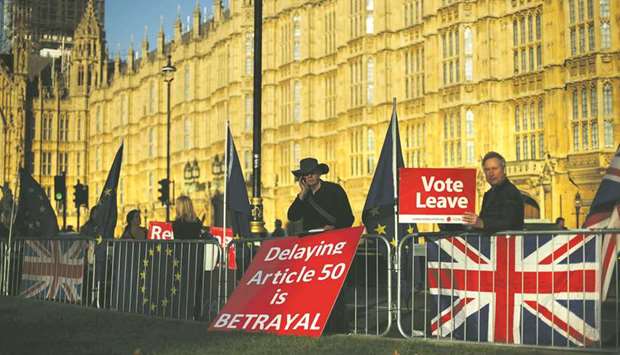
Pro-Brexit activists hold placards as they demonstrate outside of the Houses of Parliament in London yesterday.